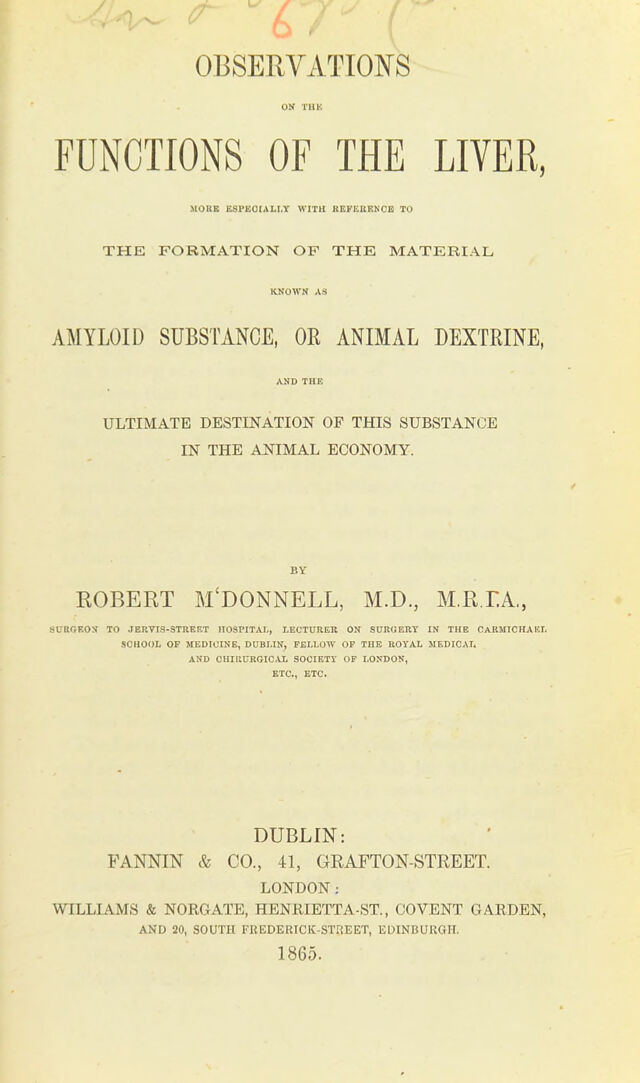
Observations on the functions of the liver : more especially with reference to the formation of the material known as amyloid substance, or animal dextrine, and the ultimate destination of this substance in the animal economy / by Robert M'Donnell.
- Robert McDonnell
- Date:
- 1865
Licence: Public Domain Mark
Credit: Observations on the functions of the liver : more especially with reference to the formation of the material known as amyloid substance, or animal dextrine, and the ultimate destination of this substance in the animal economy / by Robert M'Donnell. Source: Wellcome Collection.
Provider: This material has been provided by The Royal College of Surgeons of England. The original may be consulted at The Royal College of Surgeons of England.
35/51 page 26
![leave it by the hepatic vessels, what becomes of them 1 It is true their hydro-carbonous constituents may be thrown out as bile; but what of the nitrogen contained in them] If it does not escape by the bile-ducts, it has no other mode of exit save by the hepatic vessels. The author conceives it to be re-united with the hydro-carbonous amyloid substance, and to leave the liver as a newly-formed proteic compound, partly, perhaps, as globuline, and partly as a material in its reactions resembling caseine or albuminose, and which shall be subse- quently more fully described in this memoir. These considera- tions lead to the necessity of investigating the several distinct functions of the liver :— 1st. As to its action on the fibrine and albumen of the blood. 2nd. As to the constitution of healthy bile (so far as its azotised elements are concerned). § 3. AS TO THE RELATION, COMPOSITION, AND CHARACTERS OF THE BLOOD WHICH ENTERS AND OF THAT WHICH LEAVES THE LP7ER, AND SOME GENERAL CONSIDERATIONS AS TO THE VARIOUS FUNCTIONS PERFORMED BY THAT ORGAN. (A) Of the Functions of the Liver, as regards the Fibrine and Albumen of the Blood. It is probable that fibrine is not an agent essential to the nutrition of muscle—nay, more, there is a good deal of evidence to show that physiologists have erred in supposing that it is a formative material, necessary to the construction of muscular and other tissues. A considerable number of facts point in the very opposite direction, tending to prove that fibrine is, in some degree, the result of the disintegration of tissue. I have proved, says Dr. Brown-Sequard, that blood deprived of fibrine is as capable as normal blood of regenerating the vital properties or functions of various contractile or nervous organs. This is a fact which alone is enough to prove that fibrine is not an essential element in the nutrition of these organs, for it is to the nutrition, during the injection of the blood, that the return of the vital properties is due. If this fact is not admitted as sufficiently conclusive, I would mention](https://iiif.wellcomecollection.org/image/b22286020_0036.jp2/full/800%2C/0/default.jpg)