Origin of life : curious letters to Prof. Schäfer, amusing protests : speech at the Author's Club.
- Edward Albert Sharpey-Schäfer
- Date:
- 1913
Licence: In copyright
Credit: Origin of life : curious letters to Prof. Schäfer, amusing protests : speech at the Author's Club. Source: Wellcome Collection.
Provider: This material has been provided by The Royal College of Surgeons of England. The original may be consulted at The Royal College of Surgeons of England.
5/12
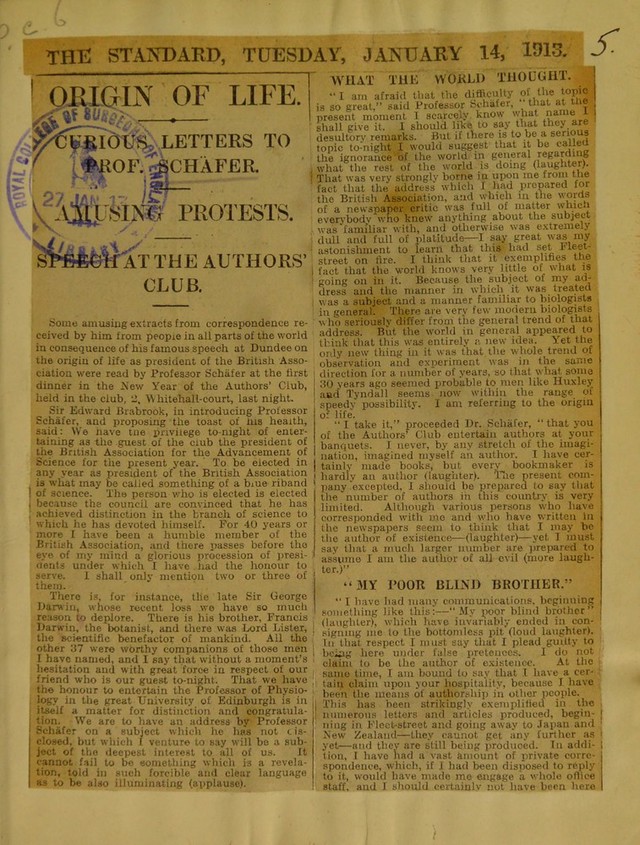
![to-night. I don't think it is fair that I should j keep these communications altogether to myself. AN EXTRAORDINARY EFFUSION. For example, I had sent to me from America a copv of a tablet whitdi “ God handed to Noah ” i (laughter). It is an extremely interesting iuscrip- ; tion, and runs:— Have ditches dug from ocean into every ] burning and boiling place, and into every abari- doned burning coal mine, and allow all bodies to float away. Drown all birds, hens, snakes, camels, llamas, all drown, and allow all bodies to float away on ocean. Never eat meat. Drown all people, old and young, allow all bodies to float awav on the ocean, never teach or preach, never have any houses or cities. Flood inside all volcanoes. Use submarine boats for deep-sea diving bells. Dig ditches from bottom of the ocean. “ I think those instructions would have been useful to Noah,” commented Dr. Schafer. “ Another communication is from a gentleman who tells me that the millennium is coming (laughter). He say the wealthy and learned win be cast off. So, gentlemen, there is not ; much chance for some of you (laughter), writers and talkers will be rejected, he adds. Then I have a lady correspondent who rejoices in the name of Lyons; she hails from Jamaica, and is probab.y a coloured lady. She is not satisfied with prose, she breaks into verse, and she en- titles ner poem, ‘ Male and Female, the Origin of he and she.’ ” The professor read the verses and said (amid laughter) that he thought there was nothing, outside some extracts from Brown- ing, to beat it. OTHER CURIOSITIES, “ Then I have been asked by many to explain 1 the Book of Genesis,” added the speaker. “ Well, I don’t intend to attempt that with Archdeacon Sinclair in the audience. Another gentleman wrote to me to say that the two most gifted men in the world have never spoken to one another. He suggested a visit (laughter). Yet another gentleman sends me a pamphlet, in which he summarises his conclusions in the fol- lowing manner‘ Alcohol is the life-giving power. And a glass of beer is the solution of life, or life in solution.’ He says: ‘You may know that because the Homans called brandy—I don’t know whether they had brandy—aqua vitae’ (laughter). A#xungst other curiosities in my correspondence was a prayer I was desired ■ to hand on without breaking the chain, so that it should go round the world. Then I had various communications from people who thought that they had discovered the mode and origin of life, and they thought ‘ it might interest me.’ ” Continuing, Professor Schafer said that he re- ceived a great many letters from people who thought he had a recipe for perpetuating life. If lie had that recipe they were not the sort of peop e to whom he would hand it (laughter). His correspondence was in many languages—English, German, Italian, but not French—and he thought the French were rather more level-minded. One 9f his correspondents said that he made an experi- ment 60 years ago. He pulled a hair out of a horse’s tad, placed it in the mud, and examined it from time to tune, and in course of time found it begin to move and wrifegle. In the writer’s opinion it had become converted into an eel, and he wrote to ask the speaker if he agreed with this (laughter). We were singularly ignorant of what other people were doing in the world, in , spite of the immense progress of journalism and ! in magazine writing, where we get a sort of mixed ’ infori. ation in regard to the progress made i in different branches of learning and science, i In ’spite of that there was extreme ignorance in regard to subjects upon which work was being tftme everv day. BELIEF IN EVOLUTION. It seemed to him extraordinary, said Pro- fessor Schafer, that there should be any persons who did not believe in evolution and evolution- ary doctrine—the backbone of modern biology and all science generally. Without the doctrine of evolution the whole of geological science would melt away and be absolutely without any founda- tion. Every master in every other science would be prepared to say the same, all of whom were absolutely dependent upon the doctrine of evolu- tion which was the same biological doctrine, although it came into prominence in the middle of the last century when Darwin published that magnificent series of researches, and that grand old Wallace (applause) published simultaneously his conclusions which agreed in so striking a ’man’ ’■ with the conclusions Darwin had formed I years miore as the result of a lifelong series of experiments. It was remarkable that even edu- cated peonle should not know that this was not | a mere opinion, though nothing positive could be j asserted. So far, however, as they could be posi- tive of anything evolution did hold the'field in science at the present day as it did in every branch of human knowledge. The urofessor thanked them for the honour t itiey had done him in entertaining him, a unique honour, for he had never for one moment thought that he would be worthy of being entertained at the Authors’ Club. Professor Alfred Caldecott said that it could not be denied that Professor Schafer had in his recent message disturbed the coloured folk and the female portion of the population in particu- lar. .Undoubtedly we all lived in profound ig- norance of what other people were thinking, and in his opinion it really wanted another sense to know what life was. It was just possible there were senses besides those of which we had actual knowledge which would give the idea of life. He did not iind in the realm of science that the law of conservation held at all. When a child i was born a new mentality came upon the scene, but had the mother lost any of her mentality f On tho other hand, when it came to death, where did it disappear to ? When Shakespeare retired, and his mentality declined^ did anyone gain by it? What other part of the cosmos took it up? Professor Starling, continuing the discussion, said that there was no such taw as conservation in the scientific world. There was a law of I change and a law of continuity. All that scientific investigators dealt with was energy, ;](https://iiif.wellcomecollection.org/image/b2243950x_0005.jp2/full/800%2C/0/default.jpg)