A treatise on diseases of the bones / By Thomas M. Markoe.
- Thomas M. Markoe
- Date:
- 1872
Licence: Public Domain Mark
Credit: A treatise on diseases of the bones / By Thomas M. Markoe. Source: Wellcome Collection.
Provider: This material has been provided by the Harvey Cushing/John Hay Whitney Medical Library at Yale University, through the Medical Heritage Library. The original may be consulted at the Harvey Cushing/John Hay Whitney Medical Library at Yale University.
369/436 page 355
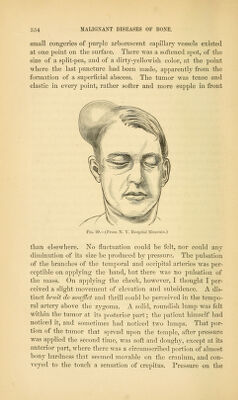
![carotid had no other effect than to stop the pulsation in the branches of the temporal and occipital arteries. Patient had no pain in the tnmor itself, but had been subject to pain across the forehead for six years previous, which came on at intervals. His general condition was good; pulse sixty-eight; appetite good, and bowels regular. From the evident vascularity of this tumor, it was thought best to try the effect of cutting off its arterial supply. This was done by Dr. Buclr, on the 21st of December, by applying a ligature to the common carotid artery, and afterward, by circumscribing the tumor, by an incision through the scalp, about an inch from its base, which encircled the w^hole tumor except about two inches in the temporal region. The vessels had of course ceased to pulsate when the carotid was tied, but each was carefully ligatured as the incision was made. The ligature came away from the carotid on the 13th day, and the incision round the tumor rapidly cicatrized. ]^o change was produced in the tumor, by this thorough operation, except the arrest of all pulsation. January 4,1840.— The tumor was again punctured ; blood flowed freely, and a probe passed in moved easily about in the substance of the tumor, as if its substance were of the consist- ence of brain. An attack of erysipelatous inflammation fol- lowed this manipulation, and the wound remained open, dis- charo-ino; bloodv fluid. January Wth.—The punctured opening has taken on a circular form of the size of a split-pea. Pressure around it does not force out any discharge. The anterior half of the tumor is softer, and its covering thinner, having much the feel of an abscess near the surface; it has subsided and is less prominent. The last two punctures were open and discharging, and a probe could be passed from one to the other. A bistoury was there- fore passed, and the communicating sinus laid open, thus largely exposing the centre of the tumor. This exposure of the mass of the tumor was followed by a gradual softening and disin- tegration of the exposed portion, pieces sometimes coming away as putrid sloughs. This process gradually destroyed the more prominent part of the tumor, but it nevertheless extended at its base until it became converted into an immense promi-](https://iiif.wellcomecollection.org/image/b21014413_0369.jp2/full/800%2C/0/default.jpg)