A treatise on diseases of the bones / By Thomas M. Markoe.
- Thomas M. Markoe
- Date:
- 1872
Licence: Public Domain Mark
Credit: A treatise on diseases of the bones / By Thomas M. Markoe. Source: Wellcome Collection.
Provider: This material has been provided by the Harvey Cushing/John Hay Whitney Medical Library at Yale University, through the Medical Heritage Library. The original may be consulted at the Harvey Cushing/John Hay Whitney Medical Library at Yale University.
378/436 page 364
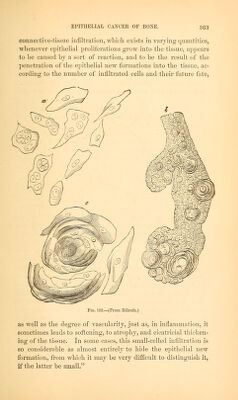
![The stroma of epitlielial growths does not seem to be con- stant or always well defined. In many cases, and I think always in bone, no proper alyeolar stroma, such as has been described in connection with medullary cancer, exists. The tissues are merely displaced for the reception of the new deposit, and what fibrous structures we find trayersing the morbid mass are prob- ably deriyed from modifications of preexistent normal tissues. In the tubular and follicular forms, the substance of the tube or follicle, which is lined by epithelium, may be supposed to be a direct derivatiye from the normal tissue, of which it is usually only an exaggeration. These tumors are permeated with a certain amount of fluid, cancer-juice, as it is called; and, as the cells have but little cohesion among themselyes, there is easily scraped off, from the cut surface, a milky fluid, which is made so by containing great numbers of the epithelial cells floating through it, sus]5ended, as in an emulsion. The clinical features of epithelioma, wherever situated, are mainly those of ulceration. Most epithelial cancers are really cancerous ulcers from their commencement. In and about the base of these ulcers, the cancerous deposit is constantly taking place, so that, as the ulcer grows, the cancer increases; and it is rather uncommon for an epithelioma to gain any great size as a tumor, on account of its constant tendency to ulcerative destruc- tion. In the bones these features are somewhat modified, ac- cording as the deposit reaches the osseous tissue from an ulcer- ated cutaneous surface, or by infection from a distant tumor. Of cases travelling subcutaneously, and infecting bones deep- seated and distant from the focus of disease, Yirchow gives one instance, in a man aged fifty-nine, who had an ulcerating epithe- lial cancer of the left breast. On the 5th of February, 1853, the left breast and several enlarged axillary glands were re- moved by operation. The man died with symptoms of pypemia, February 21st. At the autopsy, marked lesions, characteristic of pyaemia, were found. The ribs, from the third to the sixth on the right side, were infiltrated with epithelial cancer. The vertebral end of the first rib on the left side was also similarly infiltrated. In the upper part of the left mediastinum were found several small nodules of epithelial growth. There seemed](https://iiif.wellcomecollection.org/image/b21014413_0378.jp2/full/800%2C/0/default.jpg)