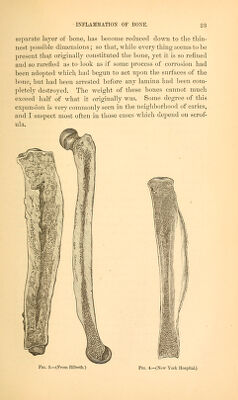
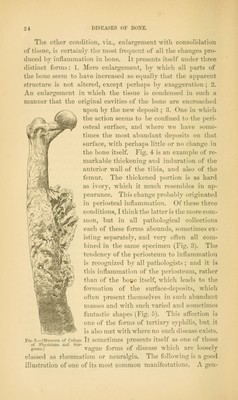
A treatise on diseases of the bones / By Thomas M. Markoe.
- Thomas M. Markoe
- Date:
- 1872
Licence: Public Domain Mark
Credit: A treatise on diseases of the bones / By Thomas M. Markoe. Source: Wellcome Collection.
Provider: This material has been provided by the Harvey Cushing/John Hay Whitney Medical Library at Yale University, through the Medical Heritage Library. The original may be consulted at the Harvey Cushing/John Hay Whitney Medical Library at Yale University.
40/436 page 26
![he is :i warm udvocate of the efficacy of the iodide in reducing intlaiiiinatioii of Ixjne, for wliich, indeed, he regards the remedy as aliM«>.>t a specitic. Tiie other conditions of enhirirement, in wliich the bone- tissue itself is more especially implicated, may be studied to great advantaso in the actions which go on around a seques- trum in an advanced case of central necrosis. There we shall find, if the case be a recent one, and the processes active, that all the original bone, around the central dead piece, takes on an involucral action, and thickens and strengthens, so as to compensate for the loss sustained. This condition may be re- garded almost as a physiological one, in which Nature adopts this method of providing for the danger intiicted by the separa- tion of the dead piece. This presents as good an illustration as we can have of simple hypertroi)hy from inflammation, and shows the bone-tissue merely increased in quaMtity, without any marked change in structure. If, however, these actions are ]n-olongiMl l)y the continued residence of the sequestrum within tlie cavity of tlie bone, then we have a gradual thicken- ing and condensation of the hitherto merely enlarged involu- cral portion, which in old cases seems to attain to the density of the hardest ivory. Besides these cases of necrosis, there are many others whose clinical history has not, so far as I know, been very thoroughly studied, where alter years of rheumatic and neuralgic pain in one or more of the bones, ])erhaps with a syphilitic or scrofulous taint of the system, and a life of habitual privation and exposure, we find after death several of the bones presenting marks of inflammation in their increased size and density, indicating processes which have been going on for years, and yet without any marked point in the history at which we can say that osteitis, as a distinct affection, commenced. The treatment of chronic inflammations of bone is not very satisfactory. Much can be accomplished, however, in the ear- lier stages, by local bloodletting, blistei*s, and the careful use of mercury, and, in the later stages, by issues and derivatives. The cases, whose pathological anatomy we have been studying, are apt to be so vague ami indistim't in their outlines during life that systematic treatment for osteitis is generally either not instituted at all, or is so mingled with other therapeutic indica-](https://iiif.wellcomecollection.org/image/b21014413_0040.jp2/full/800%2C/0/default.jpg)