A treatise on diseases of the bones / By Thomas M. Markoe.
- Thomas M. Markoe
- Date:
- 1872
Licence: Public Domain Mark
Credit: A treatise on diseases of the bones / By Thomas M. Markoe. Source: Wellcome Collection.
Provider: This material has been provided by the Harvey Cushing/John Hay Whitney Medical Library at Yale University, through the Medical Heritage Library. The original may be consulted at the Harvey Cushing/John Hay Whitney Medical Library at Yale University.
46/436 page 32
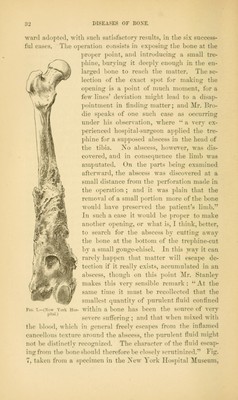
![•ward adn[)to<l, whh such satisfactory results, in the six success- ful cases. Tlie oi>cratioii consists in cx[)o&in^ the bone at the proper point, and introducing a small tre- phine, l)urvin<^ it dccj)ly encjugh in the en- large<l hone to reacli the matter. The se- lection of the exact spot for making the opening is a })oint of niucli moment, for a few lines' deviation miglit lead to a disap- pointment in finding matter; and Mr. Bro- die speaks of one such case as occurring under his observation, where a very ex- perienced liospital-snrgeon applied the tre- jihine for a supposed abscess in the head of the tibia. Ko abscess, however, was dis- covered, and in consequence the lindj was amputated. On the parts being examined afterward, the abscess was discovered at a small distance from the perforation made in the oi»eration ; and it was plain that the removal of a small portion more of the bone would have preserved the patient's limb. In such a case it would be ]»roper to make another opening, or what is, I think, better, to search for the abscess by cutting away the bone at the bottom of the trephine-cut by a small gouge-chisel. In this way it can rarely ha])pen that matter will escape de- tection if it really exists, accumulated in an abscess, though on this point Mr. Stanley makes this very sensible remark : At the same time it must be recollected that the smallest quantity of jnirulent flui<l confined within a bono has been the source of very severe sufferimx ; and that when mixed with the lilood, Mbicli in general freely escapes from tlie inflamed cancellous textnre anMuid the abscess, the pm-ulcnt fluid might not be distinctly nvognized. The character of the flnid escap- ingfrom the bone should therefore bo closely scrutinized.'' Fig. 7, taken from a specimen in the New York Hospital Museum, Fio. .—(Nt'W York Ho* j.ltal.)](https://iiif.wellcomecollection.org/image/b21014413_0046.jp2/full/800%2C/0/default.jpg)