A treatise on diseases of the bones / By Thomas M. Markoe.
- Thomas M. Markoe
- Date:
- 1872
Licence: Public Domain Mark
Credit: A treatise on diseases of the bones / By Thomas M. Markoe. Source: Wellcome Collection.
Provider: This material has been provided by the Harvey Cushing/John Hay Whitney Medical Library at Yale University, through the Medical Heritage Library. The original may be consulted at the Harvey Cushing/John Hay Whitney Medical Library at Yale University.
54/436 page 40
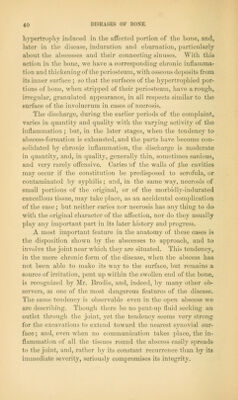
![hypertrojdiy induced \n the affected portion of tlie Lone, and, later in tlie disease, induration and eburnation, particularly about the abscesses and their connecting sinuses. With this action in the bone, we have a corresponding; chronic intiainma- tion and thickening of the periosteum, with osseous dei)Osits from its inner surface ; so that the surfaces of the hypertrophied por- tions of bone, when strip])ed of their ])eriosteuni, have a rough, irregular, granulated api)earance, in all res[)ects similar to the surface of the involucrum in cases of necrosis. The discharge, during the earlier periods of the complaint, varies in quantity and quality with the varying activity of the inflammation ; but, in the later stages, when the tendency to abscess-formation is exhausted, and the parts have become con- solidated by chronic inflammation, the discharge is moderate in quantity, and, in quality, generally thin, sometimes sanious, and very rarely offensive. Caries of the walls of J;he cavities may occur if the constitution be predisposed to scrofula, or contaminated by syphilis; and, in the same way, necrc;sis of small portions of the original, or of the morbidly-indurated cancellous tissue, may take ])lace, as an accidental complication of the case ; but neither caries nor necrosis has any thing to do with the original character of the affection, nor do they usually play any im])ortant part in its later history and progress. A most inqx>rtant feature in the anatomy of these cases is the disposition shown by the abscesses to approach, and to involve the joint near which they are situated. This tendency, in the mere chronic form of the disease, when the abscess has not been able to make its way to the surface, but remains a source of irritation, i)ent up within tlie swollen end of the bone, is recognized by Mr. lirodie, and, indeed, by many other ob- Bervei*s, as one of the most dangerous features of the disease. The same tendency is observable even in the open abscess we are describing. Tlu)Ugh there be no pent-uj) fluid seeking an outlet through the joint, yet the tendency seems very strong for the excavations to extend toward the nearest synovial sur- face; and, even when no communication takes place, the in- flammation of all the tissues round the abscess easily sj^reads to the joint, and, rather by its constant recurrence than by its immediate severity, seriously compromises its integrity.](https://iiif.wellcomecollection.org/image/b21014413_0054.jp2/full/800%2C/0/default.jpg)