Physiological and pathological researches / being a reprint of the principal scientific writings of the late T. R. Lewis ... Arranged and edited by Sir William Aitken ... G. E. Dobson ... and A. E. Brown.
- Timothy Richards Lewis
- Date:
- 1888
Licence: Public Domain Mark
Credit: Physiological and pathological researches / being a reprint of the principal scientific writings of the late T. R. Lewis ... Arranged and edited by Sir William Aitken ... G. E. Dobson ... and A. E. Brown. Source: Wellcome Collection.
Provider: This material has been provided by King’s College London. The original may be consulted at King’s College London.
44/920 page 10
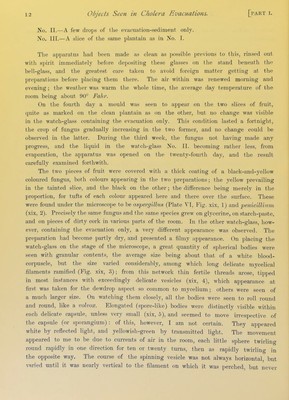
![ones, however, are those ah-eady described, namely, (1) compound cysts, consisting of fragments of various tissues and fat surrounded by a semi-organized fibro-albuminous layer, and (2) ova of various kinds, none of which are peculiar to cholera. As, however, the ultimate elements of other cysts than these might exist in the dejecta, every known method was resorted to for the purpose of developing them, a few illustrations of which I give in a condensed form. Illustration I.:— Small portions of the dejecta which contained such numbers of the cysts, alluded to in page 7 and represented at Plate III, fig. v, were placed in three perfectly clean watch-glasses with the following substances :— I. —Cholera evacuation 3 drachms, and 2 drops of acetic acid, so as to neutralize it. II. —Cholera evacuation 3 drachms, phosphate of ammonia 3 grains, grape-sugar 3 grains. III. —Distilled water 3 drachms, phosphate of ammonia 3 grains, grape-sugar 3 grains. To receive these, a small wire stand had been placed in a shallow dish containing a strong solution of permanganate of potash, and the stand and watch-glasses covered in by a bell-glass (carefully cleaned, and subsequently rinsed with alcohol) which stood in the fluid. This was set aside in an average temperature of 82° Fahr. On the third day small white specks were seen on the surface of No. I., which had returned to its alkaline condition, one of which was picked out as rapidly as possible from beneath the bell-glass and placed on the stage of the microscope. It consisted of an aggregation of minute molecules held together by a slimy substance, from which j&laments of fungi escaped (Plate IV, Fig. xv). Thus matters stood until the fifth day, when from No. II. [a speck] being picked out, presented numerous spores (Plate V, Fig. xvii, 1), many of them germinating very actively (2), and the filaments here and there were swollen out into macroconidia (3, m), some of these dilatations being transparent, others granular; frequently the filaments were seen to terminate in a bulb (4), and in one case a filament was tipped by a cyst in which the contents were granular and had contracted from the capsules (5). Precisely similar filaments and dilatations were found in No. I. but a distinct cyst (or sporangium) could not be seen. This condition lasted until the seventh day, when the mycelium gradually degenerated, and a crop of aspergillus appeared on all three, of various colours, but principally of the dark varieties. Illustration II.:— A portion of the fluid contents of the small intestine from a patient who had died within six hours of attack was carefully transferred to a vial, and allowed to settle for an hour. In the meantime a growing solution was made, consisting of grape-](https://iiif.wellcomecollection.org/image/b21296996_0046.jp2/full/800%2C/0/default.jpg)