Physiological and pathological researches / being a reprint of the principal scientific writings of the late T. R. Lewis ... Arranged and edited by Sir William Aitken ... G. E. Dobson ... and A. E. Brown.
- Timothy Richards Lewis
- Date:
- 1888
Licence: Public Domain Mark
Credit: Physiological and pathological researches / being a reprint of the principal scientific writings of the late T. R. Lewis ... Arranged and edited by Sir William Aitken ... G. E. Dobson ... and A. E. Brown. Source: Wellcome Collection.
Provider: This material has been provided by King’s College London. The original may be consulted at King’s College London.
840/920 page 658
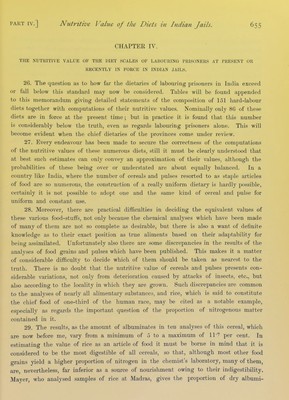
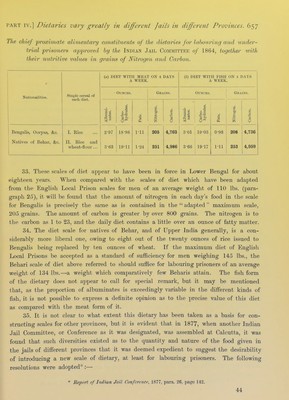
![I. —That labouring prisoners sentenced for terms not exceeding three months should receive less than labour- ing prisoners sentenced for longer terms. Opinions were tod conflicting to admit of our coming to any resolution as to the amount of reduction. II. —That the following scale be laid down as a maximum for adult male prisoners sentenced to hard labour :- - (1) Grain 28 oz. (including 4 oz. pulse) in the form of sifted Hour, or 26 oz. in the case of wheat, rice or barley. (2) Green vegetables 6 oz. (3) Fatty matter ] oz. (4) Salt i oz. (5) Condiments ^ oz., pepper from jail garden. (6) Firewood 1 lb. N.B.—Whenever it may be considered necessary, 4 oz. meat or fish, or an equivalent of milk, may be given instead of 4 oz. grain. It i.1 to he understood tliat reduction in one or more of the ahore articlefi does not wan-ant increase in any other. III. —That meat is not a necessary article of diet, except in the case of Natives who are in the habit of eating it in free life (Dr. Henderson dissented from this resolution). 36. A comparison of the scales of diet recommended by this Conference with those approved by the Committee of 1864 shows that the principal difference consists in the adoption of the principle that the issue of animal food should be left to the discretion of the local jail authorities instead of making it a compulsory article of the labouring and under-trial dietary. In doing this it would seem that the Conference was influenced by the satisfactory experience which the jails of the North-West Provinces and Oudh, and also of the Central Provinces, furnished of the dieting of all prisoners without the issue of any animal food whatever. In the face of such experience it would have been manifestly unwise to recommend that the jail authorities of any province should be compelled to adopt an expensive article of food when experience had shown that it was unnecessary in some provinces. In connection with this matter the following remarks by the Committee on English I^ocal Prison dietaries may be appropriately cited :— There would be no difficulty in constructing a diet containing nutritive principles equal to those of meat out of oatmeal, peas, beans and fats, and this could be done at a third or fourth of the cost incurred by depending entirely upon the animal kingdom for these alimentary products. * 37. With regard to the apportioning of the quantities of grains and pulses, noted under clause (1) of the second resolution of the Conference, some confusion is manifest in the text, possibly owing to the transposition of the figures dealing with the quantities of the sifted flour and grain which are suggested for the various dietaries. The superiority of finely-sifted flour over the grain in its crude condition is so obvious as to be manifest on a moment's reflection. It is therefore probable that the text of the resolution of the Conference should be read thus :— 26 ounces (including 4 oz. pulse) of sifted JioiLT, and 28 oz. of grain in the case of wheat, rice or barley. This is the interpretation which has been adopted in calculating the nutritive values of some of the principal forms into which the dietary which they recommended may be resolved. It is, however, * A liejm't on Dietaries in Prisons submitted to Parliament in March 1878, page 31.](https://iiif.wellcomecollection.org/image/b21296996_0844.jp2/full/800%2C/0/default.jpg)