Physiological and pathological researches / being a reprint of the principal scientific writings of the late T. R. Lewis ... Arranged and edited by Sir William Aitken ... G. E. Dobson ... and A. E. Brown.
- Timothy Richards Lewis
- Date:
- 1888
Licence: Public Domain Mark
Credit: Physiological and pathological researches / being a reprint of the principal scientific writings of the late T. R. Lewis ... Arranged and edited by Sir William Aitken ... G. E. Dobson ... and A. E. Brown. Source: Wellcome Collection.
Provider: This material has been provided by King’s College London. The original may be consulted at King’s College London.
846/920 page 664
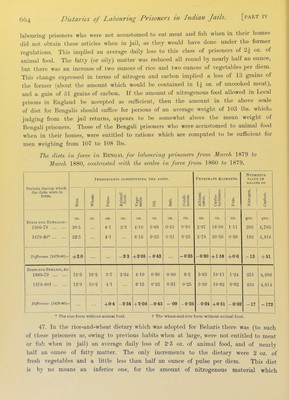
![labouring prisoners who were not accustomed to eat meat and fish when in their homes did not obtain these articles when in jail, as they would have done under the former regulations. This implied an average daily loss to this class of prisoners of 2^ oz. of animal food. The fatty (or oily) matter was reduced all round by nearly half an ounce, but there was an increase of two ounces of rice and two ounces of vegetables per diem. This change expressed in terms of nitrogen and carbon im^jlied a loss of 13 grains of the former (about the amount which would be contained in ^ oz. of uncooked meat), and a gain of 51 grains of carbon. If the amount of nitrogenous food allowed in Local prisons in England be accepted as sufficient, then the amount in the above scale of diet for Bengalis should suffice for persons of an average weight of 103 lbs. which, judging from the jail returns, appears to be somewhat above the mean weight of Bengali prisoners. Those of the Bengali prisoners who were accustomed to animal food when in their homes, were entitled to rations which are computed to be sufficient for men weighing from 107 to 108 lbs. The diets in fm-ce in Bengal /or labouring prisoners from March 1879 to March 1880, contrasted ivith the scales in force from 1860 to 1879. Periods during which the diets were in force. ItfGKEDIF.NTS CONSTITUTING THE DIETS. Peoximate Aliments. Nutritive VALUE IN GUAINB OF Rice. Wheat. Pulse. Animal food. Vege- 1 table. o Salt. Condi- ments. Albumi- nates. Carbo- hydrates. Fats. Nitrogen. Carbon. Diets for Bkngai.is— 18t)0-79 oz. •20-5 oz. oz. 4-1 oz. 2-3 oz. 4-10 oz. 0-68 oz. 0-.51 oz. 0-50 oz. 2-97 oz. 18-98 oz. 1-11 grs. 205 grn. 4,763 1879-80* 22-5 4-1 6-15 0-25 0-51 0-25 2-78 20-56 0-50 192 4,814 Difference [1879-801= +2.0 -23 +205 -0-43 -0 25 -0 90 +1-58 +06 -13 + 51 Diets fobBeharis, &c. 1860-79 12-3 10-2 3-7 2-34 4-10 0-68 0-60 0-5 3-63 19-11 1 1-24 251 4,986 1879-80t 12-8 10-2 4-1 1 6-15 0-25 0-61 0-25 3-39 19-62 0-62 234 4,814 VifTerence [1879-80]= +0-4 -2-34 +206 -043 -09 -0 25 -0-24 +0-51 -0 62 -17 -172 * The rice form without animal food. + The wheat-and-rice form without animal food. 47. In the rice-and-wheat dietary which was adopted for Beharis there was (to such of these prisoners as, owing to previous habits when at large, were not entitled to meat or fish when in jail) an average daily loss of 2-3 oz. of animal food, and of nearly half an ounce of fatty matter. The only increments to the dietary were 2 oz. of fresh vegetables and a little less than half an ounce of pulse per diem. This diet is by no means an inferior one, for the amount of nitrogenous material which](https://iiif.wellcomecollection.org/image/b21296996_0850.jp2/full/800%2C/0/default.jpg)