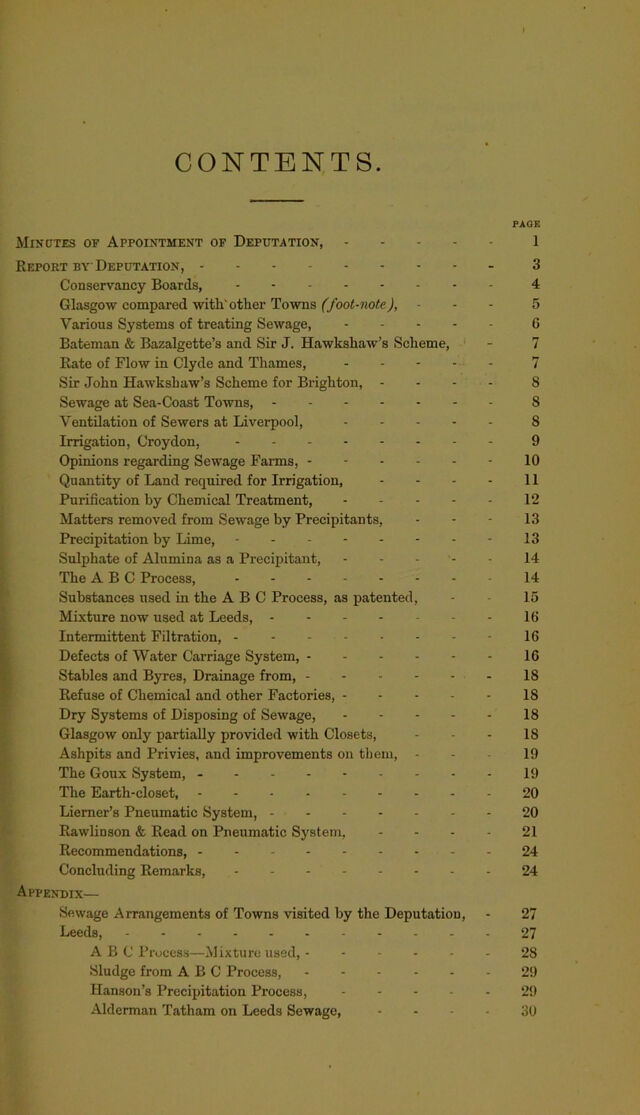
Report by the deputation appointed by the Town Council and Board of Police of Glasgow to inquire into the methods of disposing of sewage adopted in various towns in England.
- Glasgow (Scotland). Town Council
- Date:
- 1878
Licence: Public Domain Mark
Credit: Report by the deputation appointed by the Town Council and Board of Police of Glasgow to inquire into the methods of disposing of sewage adopted in various towns in England. Source: Wellcome Collection.
Provider: This material has been provided by The Royal College of Surgeons of England. The original may be consulted at The Royal College of Surgeons of England.
53/56 page 49
![f 49 working expenses connected therewith, and tliat means must therefore be nsed for getting rid of it without reference to possible profit. 3. In towns where a watei’-carried system is employed, a rapid flow, thorough ventilation, a proper connection of the house drains and pipes with the sewers, and their arrangement and maintenance in an efficient condition, are absolutely essential as regards health; hitherto sufficient precautions have rarely been taken for efficiently ensuring all the fore- going conditions. ' 4. With regard to the various dry systems, where collection at short intervals is properly carried out, the result appears to be satisfactory, but no really profitable application of any one of them appears as yet to have been accomj)]ished. 5. The old midden or privy system in jDopulous districts should be discontinued, and prohibited by law. 6. Sufficient infoinnation was not brought forward at the Con- ference to enable the Committee to express an opinion in regard to any of the foreign systems. 7. It was conclusively shown that no one system for disposing of sewage could be adopted for universal use; that different localities require different methods to suit their special peculiarities; and also that, as a rule, no profit can be derived at present from sewage vitilization. 8. For health’s sake, without consideration of commercial profit, sewage and excreta must be got rid of at any cost. The Executive Committee, whilst abstaining from submitting any extensive measures, have no hesitation in recommending that the prevention of dangerous effects from sewage gases should receive the immediate attention of the Legislature, and they submit the following resolutions as the basis of petitions to Parliament :— 1. Tliat the protection of public health from typhoid and other diseases demands that an amending Act of Parliament be passed as soon as possible, to secure that all house drains connected with public sewers in the metropolis, and towns having an urban authority, should be placed under the in- spection of Local Sanitary Authorities, who shall be bound to see to the effective construction and due maintenance of all such house drains, pipes, and connections. Provisions having this object in view already exist in the Act constitut- ing the Commissioners of Sewers in the City of London, in the Metropolis Local Management Act, 1855, and in the Public Health Act, 1875, but practically they seem scarcely sufficient for the purpose. 2. That plans of such drains and connections be deposited in the charge of the respective Local Authorities, who shall be](https://iiif.wellcomecollection.org/image/b22412165_0055.jp2/full/800%2C/0/default.jpg)