Licence: Public Domain Mark
Credit: Practical manual of obstetrics. Source: Wellcome Collection.
Provider: This material has been provided by the Harvey Cushing/John Hay Whitney Medical Library at Yale University, through the Medical Heritage Library. The original may be consulted at the Harvey Cushing/John Hay Whitney Medical Library at Yale University.
61/430 page 31
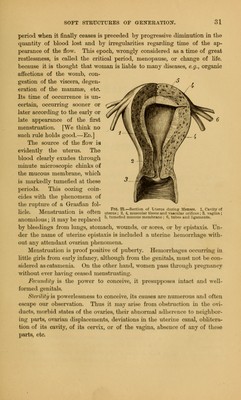
![period when it finally ceases is preceded by progressive diminution in the quantity of blood lost and by irregularities regarding time of the ap- pearance of the flow. This epoch, wrongly considered as a time of great restlessness, is called the critical period, menopause, or change of life, because it is thought that woman is liable to many diseases, e.g., organic affections of the womb, con- gestion of the viscera, degen- eration of the mammse, etc. Its time of occurrence is un- certain, occurring sooner or later according to the early or late appearance of the first menstruation. [We think no such rule holds good.—Ed.] The source of the flow is evidently the uterus. The blood clearly exudes through minute microscopic chinks of the mucous membrane, which is markedly tumefied at these periods. This oozing coin- cides with the phenomena of the rupture of a Graafian fol- v , ,r , ,. . p, FIG. 23.—Section of Lterus during Men???. 1. Cavity of UCle. Menstruation IS Otteil uterus: t, ■». muscular tissue and vascular orifloes; 3. vagina; i •, i i i 5, tumefied mucous membrane; (i, tubes and ligaments. anomalous; it may be replaced b by bleedings from lungs, stomach, wounds, or sores, or by epistaxis. Un- der the name of uterine epistaxis is included a uterine hemorrhage with- out any attendant ovarian phenomena. Menstruation is proof positive of puberty. Hemorrhages occurring in little girls from early infancy, although from the genitals, must not be con- sidered as catamenia. On the other hand, women pass through pregnancy without ever having ceased menstruating. Fecundity is the power to conceive, it presupposes intact and well- formed genitals. Sterility is powerlessnees to conceive, its causes arc numerous and often escape our observation. Thus it may arise from obstruction in the ovi- ducts, morbid states of the ovaries, their abnormal adherence to neighbor- ing parts, ovarian displacements, deviations in the uterine canal, oblitera- tion of its cavity, of its cervix, or of the vagina, absence of any of these parts, etc.](https://iiif.wellcomecollection.org/image/b2100013x_0061.jp2/full/800%2C/0/default.jpg)