Licence: Public Domain Mark
Credit: Practical manual of obstetrics. Source: Wellcome Collection.
Provider: This material has been provided by the Harvey Cushing/John Hay Whitney Medical Library at Yale University, through the Medical Heritage Library. The original may be consulted at the Harvey Cushing/John Hay Whitney Medical Library at Yale University.
82/430 page 52
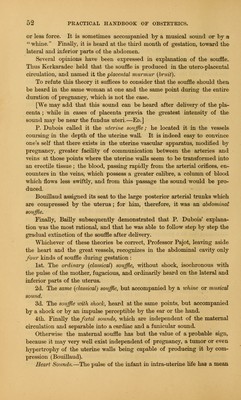
![or less force. It is sometimes accompanied by a musical sound or by a whine. Finally, it is heard at the third month of gestation, toward the lateral and inferior parts of the abdomen. Several opinions have been expressed in explanation of the souffle. Thus Kerkaradec held that the souffle is produced in the utero-placental circulation, and named it the placental murmur (bruit). To refute this theory it suffices to consider that the souffle should then be heard in the same woman at one and the same point during the entire duration of pregnancy, which is not the case. [We may add that this sound can be heard after delivery of the pla- centa ; while in cases of placenta prsevia the greatest intensity of the sound may be near the fundus uteri.—Ed.] P. Dubois called it the uterine souffle; he located it in the vessels coursing in the depth of the uterine wall It is indeed easy to convince one's self that there exists in the uterine vascular apparatus, modified by pregnancy, greater facility of communication between the arteries and veins at those points where the uterine walls seem to be transformed into an erectile tissue ; the blood, passing rapidly from the arterial orifices, en- counters in the veins, which possess a greater calibre, a column of blood which flows less swiftly, and from this passage the sound would be pro- duced. Bouillaud assigned its seat to the large posterior arterial trunks which are compressed by the uterus; for him, therefore, it was an abdominal souffle. Finally, Bailly subsequently demonstrated that P. Dubois' explana- tion was the most rational, and that he was able to follow step by step the gradual extinction of the souffle after delivery. Whichever of these theories be correct, Professor Pajot, leaving aside the heart and the great vessels, recognizes in the abdominal cavity only four kinds of souffle during gestation : 1st. The ordinary (classical) souffle, without shock, isochronous with the pulse of the mother, fugacious, and ordinarily heard on the lateral and inferior parts of the uterus. 2d. The same (classical) souffle, but accompanied by a whine or musical sound. 3d. The souffle with shock, heard at the same points, but accompanied by a shock or by an impulse perceptible by the ear or the hand. 4th. Finally the foetal sounds, which are independent of the maternal circulation and separable into a cardiac and a funicular sound. Otherwise the maternal souffle has but the value of a probable sign, because it may very well exist independent of pregnancy, a tumor or even hypertrophy of the uterine walls being capable of producing it by com- pression (Bouillaud). Heart Sounds.—The pulse of the infant in intra-uterine life has a mean](https://iiif.wellcomecollection.org/image/b2100013x_0082.jp2/full/800%2C/0/default.jpg)