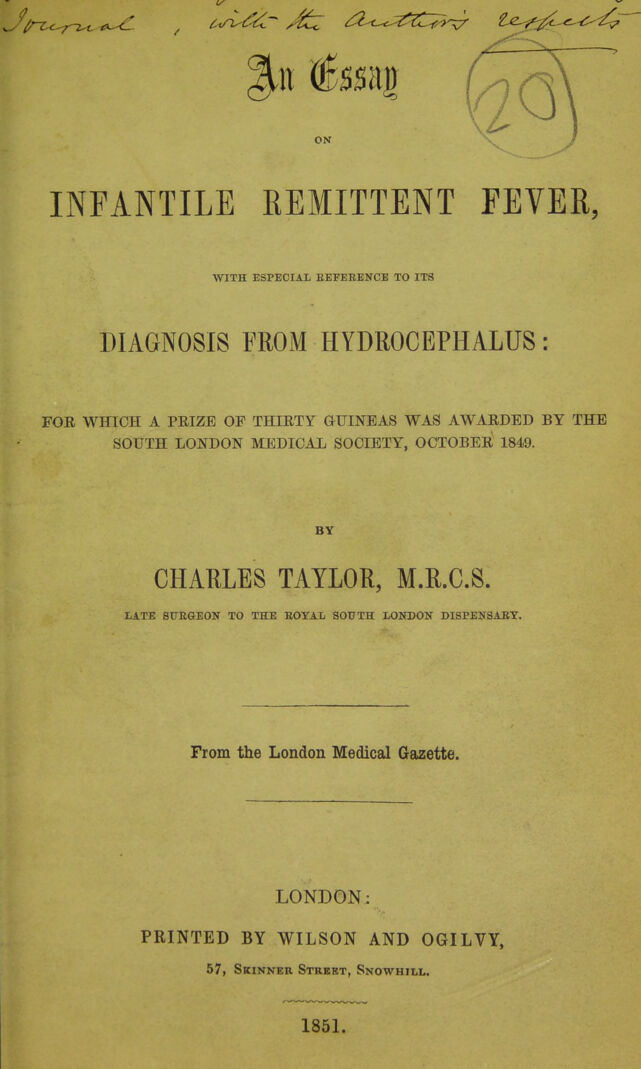
An essay on infantile remittent fever, with especial reference to its diagnosis from hydrocephalus : for which a prize of thirty guineas was awarded by the South London Medical Society, October 1849 / by Charles Taylor, M.R.C.S.
- Taylor, Charles, M.R.C.S.
- Date:
- 1851
Licence: Public Domain Mark
Credit: An essay on infantile remittent fever, with especial reference to its diagnosis from hydrocephalus : for which a prize of thirty guineas was awarded by the South London Medical Society, October 1849 / by Charles Taylor, M.R.C.S. Source: Wellcome Collection.
Provider: This material has been provided by The University of Glasgow Library. The original may be consulted at The University of Glasgow Library.
6/44 page 4
![Baglivi and Van der Bosch. Sauvagcs and Hoffman were of this opinion. But as medical science advanced, and facts wei-e more carefully inquired into, it was found that the presence or absence of worms did not alter the character of the disease ; and Sir J. Pringle, and Sarcome, remarked that their presence required scarcely any modification in the treatment; while Bianchini in Italy, andDe Haen in Germany, pointed out how exaggerated was the influence attnbuted to them. Prof. Sinclair, of Edinburgh, proved that worms were not always discovered in the so-called worm fever.* Dr William Hunter declared he had searched for them in vain in the bodies of those who were said to have died of such disorders. Musgi'ave also proved that those affec- tions were less attributable to worms than to the presence of sabiuTse in the primse vise; and Dr. Clarke, of New- castle, remarks, in his work on Fever, on the impropriety of the teiin worm fever, and that anthelmintics will rarely, if ever, cure it. Such were the opinionsof medicalmen, when, in 1772, the work of Dr. Butter on Infantile Remittent Fever ap peared, since which time the disease has been written on, or referred to, by many authors on diseases of children ; Dr. Butter's description being the chief authority and guide. Dr. Pemberton,f in his work on dis eases of the abdominal viscera, follows Dr. Butter's descriiJtion; and Dr. Simsl has given an account of an epidemic infantile remittent fever which occur red simultaneously with low nervous fever, of a remittent character, in adults. Dr. Cheyne§ has also given us some good practical remarks on it, especially in reference to its connection with hy- drocephalus. Since then. Dr. Milman Coleyll has written a separate treatise on the subject: it has also been de- scribed, or alluded to, by Drs. Mason Good,1[ Mackintosh,** Sir H. Marsh,-|-f- Underwoodj^ and his commentators; * Cyclopoedia of Practical Medicine, vol. 1. Art. Remittent Fever, Joy. t Pemberton's Practical Treatise on Diseases of Abdominal Viscera. t J. Sims, Observations on Epidemic Dis- orders. London. Svo. P. IfiS. § Clieyne's Monograpli on Hydrocephalus. II Coley's Treatise on Uemittent Fevers of Infants. % Dr. Mason Good's Study of Medicine. ♦* Mackintosh's Practice of Physic. +t Dublin Hospital Reports, vol. iii. ii On Diseases of Cliiidrei.. .'iirious editions. Marshall Hall,Men-iman, and H.Davies; Joy,* Maunsell,! Evanson; Cop- land,^ Hughes,§GoldingBird,|| Locock,1I West,** and Willshire while, on the Continent, Rilliett and Barthez,*| and others, have added to our information on the subject. Whether the disease termed in- fantile remittent fever is referable to the second or third of my divisions, a])- pears to be an undecided question, for, as will be shown, the ojjinions of au- thors vary on this point; some consi- dering it an affection symptomatic of irritation and inflammation of the di- gestive tube, whilst others consider it an idiopathic fever, and identical with continued fever in the adult. At the risk of being thought tedious, J will quo;e some of these opinions. As before remai'ked, in former times the presence of woitos in the intestinal canal was considered the chief, if not the only, cause. Dr. Butter considered it owing to a weak state of the digestive organs, mor- bid accumulation in the primse via3, and the peculiar irritability and proneness to fever in infancy. Pemberton also describes it as de- pending on intestinal irritation. Joy considers it merely a variety of gastric fever modified by the mi table constitution of infancy, and, in confir- mation of his views, draws attention to the sym])toms. Richter considered every fever of a remittent character as more or less gastric ; and Selle recognised no other Ibi-m of remittent fever than gastric and hectic. Dr. Sims, in his account of an epide- mic, says it attacked those who had derangement of the intestines for a length of time, as picking of the nose, grinding of the teeth, &c. Dr. Locock terms it, infantile gas- tric remittent fever, and considers the causes are those which indirectly or di- rectly afiect the digestive organs ; and remarks that there is a striking con- « Cyclopjedia of Practical Medicine, vol. i. t On Diseases of Children. ... t Dictionary of Practical Medicine, part iii. § Guy's Hospital Reports, old series. II Ibid, new series. . . , , % Library of Practical Medicine, art. Infantile Gastric Remittent Fever. ** Lectures in Med. Gaz. vi., vii., xxxvii.; and Diseases of Children. tt Lectures in Med. Times, 1848. Traitd I'ratique dcs Maladies des Enfans, toni. iii. p. 350. d sequent.](https://iiif.wellcomecollection.org/image/b21475477_0006.jp2/full/800%2C/0/default.jpg)