Leprosy in India : a report / by T.R. Lewis and D.D. Cunningham.
- Timothy Richards Lewis
- Date:
- 1877
Licence: Public Domain Mark
Credit: Leprosy in India : a report / by T.R. Lewis and D.D. Cunningham. Source: Wellcome Collection.
Provider: This material has been provided by The Royal College of Surgeons of England. The original may be consulted at The Royal College of Surgeons of England.
31/88 page 25
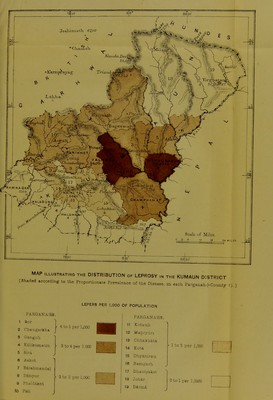
![and comparing the various entries in the detailed census returns for the several years, and taking into consideration the general impression entertained by so many of the officials in the district whom we consulted, and especially of such of the officers whose duties have constantly taken them for several years past into immediate contact with the population of even the remotest villages, we are of opinion that the number of lepers has not diminished to the extent which the last census returns imply, so that probably the earlier cen- suses were more exact than the last regarding this matter. The following fact appears to support this view :— A reference to Table 5 on page 22 will show that in the census of 1852 the number of male to female lepers was nearly as 4 to 1, whereas in the last census the number of male was almost ten times that of the female lepers—a proportion which seems to be farther from the truth than that yielded by the earlier census. On a future occasion we hope to be able to submit more precise data regarding this matter; at present our impression is, that although leprosy is probably decreasing in the district, the decrease is not quite to the extent suggested by the figures. 3.—The Geographical Distribution of Leprosy in Kwmaun. With the view of carrying out to the fullest extent prac- ticable the suggestion of the ^^L]^S^^:ZXvt:tll'^ Army Sanitary Commission al- ready referred to, that not only the numerical data but the precise localities where leprosy prevails should be ascertained, we have kept not only the re- cords of each pargana (= county?) distinct for itself for the different years, but also the data regarding each patti (= parish?), and every town and village within its limits. The information thus collected was graphically represented on charts of the district so as to ascertain whether a more clear conception of the distribution of the malady could be obtained by this means than was obtainable by a study of the figures alone. It was our intention originally to have reproduced the greater portion of these charts, but we found that they all told pretty much the same story, and we have therefore decided on reproducing merely the chart which illustrates the distribution of the disease as deduced from the average ratios of the three censuses. We have, however, reproduced a condensed tabular statement showing the pre- valence of the disease in the various parganas for all the](https://iiif.wellcomecollection.org/image/b22287619_0033.jp2/full/800%2C/0/default.jpg)