Notes on analytical chemistry for students in medicine : extracted from the fifth edition of "Notes for students in chemistry" / by Albert J. Bernays.
- Albert Bernays
- Date:
- 1889
Licence: Public Domain Mark
Credit: Notes on analytical chemistry for students in medicine : extracted from the fifth edition of "Notes for students in chemistry" / by Albert J. Bernays. Source: Wellcome Collection.
Provider: This material has been provided by University of Bristol Library. The original may be consulted at University of Bristol Library.
126/182 (page 114)
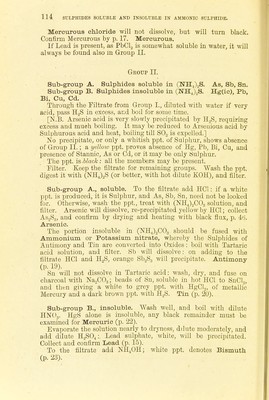
![Mercurous chloride will not dissolve, but will turn black. Confimi Mercurous by p. 17. Mercurous. If Lead is present, as PbCl2 is somewhat soluble in water, it will always be found also m Group II. Group II. Sub-group A. Sulphides soluble in (NH4)2S. As, Sb, Sn. Sub-group B. Sulphides insoluble in (NHJ2S. Hg(ic), Pb, Bi, Cu, Cd. Through the Filtrate from Group L, diluted with water if very acid, pass H2S in excess, and boil for some time. [N.B. Arsenic acid is very slowly precipitated by H2S, requiring excess and mueh boiling. It may be reduced to Arseuious acid by Sulphurous acid and heat, boiling till S02 is expelled.] No precipitate, or only a whitish ppt. of Sulphur, shows absence of Group II.; a yelloiv ppt. proves absence of Hg, Pb, Bi, Cu, and presence of Stannic, As or Cd, or it may be only Sulphur. The ppt. is-black: all the members may be present. Filter. Keep the filtrate for remaining groups. Wash the ppt. digest it with (NH4)2S (or better, with hot dilute KOH), and filter. Sub-group A., soluble. To the filtrate add HC1: if a white ppt. is produced, it is Sulphur, and As, Sb, Sn, need not be looked for. Otherwise, wash the ppt., treat with (NH,)2C03 solution, and filter. Arsenic will dissolve, re-precipitated yellow by HCl; collect As2S3, and contirm by drying and heating with black flux, p. 4tj. Arsenic. The portion insoluble in (NH4)2C03 should be fused with Ammonium or Potassium nitrate, whereby the Sulphides of Antimony and Tin are converted into Oxides: boil with Tartaric acid solution, and filter. Sb will dissolve: on adding to the filtrate HCl and H2S, orange Sb2S3 will precipitate. Antimony (p. 19). Sn will not dissolve in Tartaric acid: wash, dry, and fuse on charcoal with Na2C03; beads of Sn, soluble in hot HCl to SnCl2, and then giving a white to grey ppt. with HgCI2, of metallic Mercury and a dark brown ppt. with H2S. Tin (p. 20). Sub-group B., insoluble. Wash well, and boil with dilute HN03. HgS alone is insoluble, any black remainder must be examined for Mercuric (p. 22). Evaporate the solution nearly to dryness, dilute moderately, and add dilute H2S04: Lead sulphate, white, will be precipitated. Collect and confirm Lead (p. 15). To the filtrate add NH4OH; white ppt. denotes Bismuth (p. 23).](https://iiif.wellcomecollection.org/image/b21447676_0126.jp2/full/800%2C/0/default.jpg)