Notes on analytical chemistry for students in medicine : extracted from the fifth edition of "Notes for students in chemistry" / by Albert J. Bernays.
- Albert Bernays
- Date:
- 1889
Licence: Public Domain Mark
Credit: Notes on analytical chemistry for students in medicine : extracted from the fifth edition of "Notes for students in chemistry" / by Albert J. Bernays. Source: Wellcome Collection.
Provider: This material has been provided by University of Bristol Library. The original may be consulted at University of Bristol Library.
131/182 (page 119)
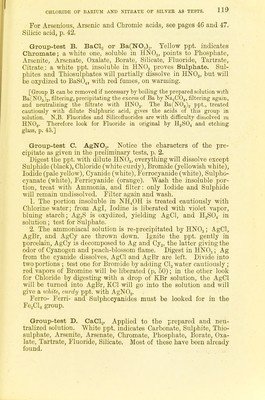
![For Arsenious, Arsenic and Chromic acids, see pages 46 and 47. Silicic acid, p. 42. Group-test B. BaCl2 or Ba(N03)2. Yellow ppt. indicates Chromate; a white one, soluble in HN03, points to Phosphate, Arsenite, Arsenate, Oxalate, Borate, Silicate, Fluoride, Tartrate, Citrate : a white ppt. insoluble in HN03 proves Sulphate. Sul- phites and Thiosulphates will partially dissolve in HN03, but will be oxydized to BaS04, with red fumes, on warming. [Group B can be removed if necessary by boiling the prepared solution with Ba(N03)2, filtering, precipitating the excess of Ba by Na2C03, filtering again, and neutralizing the filtrate with HN03. The Ba(N03)2 ppt., treated cautiously with dilute Sulphuric acid, gives the acids of this group in solution. N.B. Fluorides and Silicofluorides are with difficulty dissolved in HN03. Therefore look for Fluoride in original by H2S04 and etching glass, p. 45.] Group-test C. AgN03. Notice the characters of the pre- cipitate as given in the preliminary tests, p. 2. Digest the ppt. with dilute HN03, everything will dissolve except Sulphide (black), Chloride (white curdy), Bromide (yellowish white), Iodide (pale yellow), Cyanide (white), Ferrocyanide (white), Sulpho- cyanate (white), Ferricyanide (orange). Wash the insoluble por- tion, treat with Ammonia, and filter: only Iodide and Sulphide will remain undissolved. Filter again and wash. 1. The portion insoluble in NH4OH is treated cautiously with Chlorine water; from Agl, Iodine is liberated with violet vapor, bluing starch; Ag2S is oxydized, yielding AgCl, and H2S04 in solution; test for Sulphate. 2. The ammoniacal solutionis re-precipitated byHN03; AgCl, AgBr, and AgCy are thrown down. Ignite the ppt. gently in porcelain, AgCy is decomposed to Ag and Cy2, the latter giving the odor of Cyanogen and peach-blossom flame. Digest in HN03; Ag from the cyanide dissolves, AgCl and AgBr are left. Divide into two portions ; test one for Bromide by adding Cl2 water cautiously ; red vapors of Bromine will be liberated (p. 50); in the other look for Chloride by digesting with a drop of KBr solution, the AgCl will be turned into AgBr, KC1 will go into the solution and will give a white, curdy ppt. with AgN03. Ferro- Ferri- and Sulphccyanides must be looked for in the Fe2Cl6 group. Group-test D. CaCl2. Applied to the prepared and neu- tralized solution. White ppt. indicates Carbonate, Sulphite, Thio- sulphate, Arsenite, Arsenate, Chromate, Phosphate, Borate, Oxa- late, Tartrate, Fluoride, Silicate. Most of these have been already found.](https://iiif.wellcomecollection.org/image/b21447676_0131.jp2/full/800%2C/0/default.jpg)