Notes on analytical chemistry for students in medicine : extracted from the fifth edition of "Notes for students in chemistry" / by Albert J. Bernays.
- Albert Bernays
- Date:
- 1889
Licence: Public Domain Mark
Credit: Notes on analytical chemistry for students in medicine : extracted from the fifth edition of "Notes for students in chemistry" / by Albert J. Bernays. Source: Wellcome Collection.
Provider: This material has been provided by University of Bristol Library. The original may be consulted at University of Bristol Library.
132/182 (page 120)
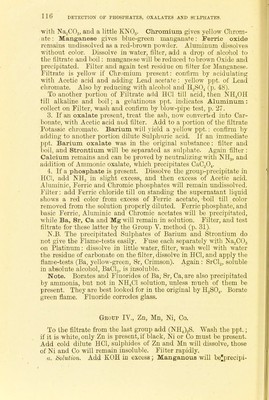
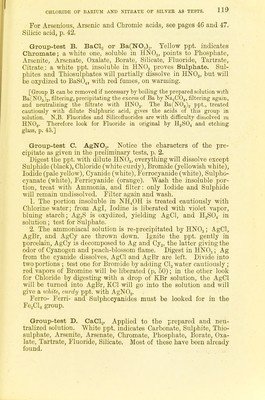
![USE OF CALCIUM CHLORIDE AND FERRIC CHLORIDE. Wash the ppt. Ignite a portion on Platinum. If it chars, a vegetable acid is present Tartrate, burnt-sugar odor, etc. Burn white, dissolve in HC1, and test for inorganic acids. If it does not char; Tartrate, etc., are absent. Digest the ppt. in acetic acid; all the Calcium salts will dissolve except Oxalate and Fluoride. Heat the original with H2S04; glass etched; Fluoride. Ignite the ppt. on platinum; a carbonate formed, effervescing with HN03, indicates Oxalate. The ash can be dissolved in HC1 and tested for inorganic acids of this group. Ignite some of the prepared solution on platinum with H2S04. Green mantle flame indicates Borate. Confirm by turmeric test, p. 47. Warm a few drops of the original solution, acidified with HN03, with Ammonium molybdate,• yellow ppt. indicates Phosphate, or Arsenate. Test for Arsenicum by Marsh's and Eeinsch's test, p. 47. If not present, it must be Phosphate. When Arsenate is present, boil down nearly to dryness with H2S03, dilute, add HCl and precipitate Arsenicum by H2S; the filtrate will contain the Phosphate; boil off H2S and try molybdate again. [To separate tartaric and citric acids, saturate with milk of lime; calcium tartrate precipitates. The filtrate, on boiling, throws down calcium citrate.] Group-test E. Fe2Cl6 (free from Ferrous). Use the prepared solution. 1. A precipitate. Test it with Acetic acid and with HC1. (a) Soluble in Acetic acid and in HCl; Borate, yellowish ppt.; Benzoate, buff colored, with HC1 gives scales of Benzoic acid; Succinate, red-brown, with HC1 no crystals; Hippurate, flesh- colored, with HC1 gives needles of hippuric acid; Urate, red-brown, with HC1 a white minutely crystalline ppt. of Uric acid (Group A). (&) Soluble in HCl, but not in Acetic acid ; Phosphate, Arsenate, already found ; Tannate, blue-black very finely divided ppt.; Gallate, black ppt.; with HCl yellow color, with ppt. of Gallic acid; Pyrogallate, brown-red ppt. Salts uncommon. HCl, yellow color. With KOH, dark brown. (c) Insoluble in HCl; Ferroeyanide, dark blue. [To separate Hippurate, Benzoate and Succinate, add to the Fe2Cl6 ppt. Hydrochloric acid and ether; Benzoic acid is very soluble in ether and must be removed in the ethereal layer ; to the filtrate add Ammonia, alcohol and BaCl2; Barium succinate precipitates; the filtrate treated with Na2C03, to remove the Barium, and filtered, on evaporation and addition of HCl gives needles of Hippuric acid. When Tannic and Gallic acids occur together, the cautious addition of gelatin solution will precipitate Tannic and leave Gallic acid. The separation of acids in this group is very difficult, but they are rarely given together.]](https://iiif.wellcomecollection.org/image/b21447676_0132.jp2/full/800%2C/0/default.jpg)