Notes on analytical chemistry for students in medicine : extracted from the fifth edition of "Notes for students in chemistry" / by Albert J. Bernays.
- Albert Bernays
- Date:
- 1889
Licence: Public Domain Mark
Credit: Notes on analytical chemistry for students in medicine : extracted from the fifth edition of "Notes for students in chemistry" / by Albert J. Bernays. Source: Wellcome Collection.
Provider: This material has been provided by University of Bristol Library. The original may be consulted at University of Bristol Library.
151/182 (page 139)
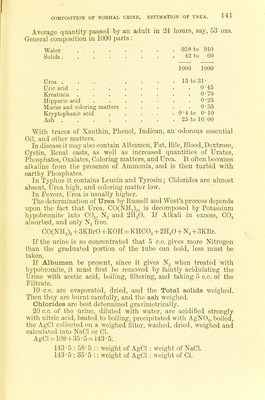
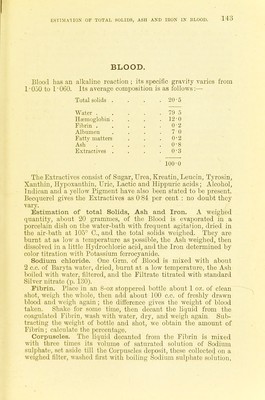
![water. Amnionic sulphide will indica'e the presence of iron. On reducing the hulk of the water to one-tenth, Potas ium ferrooyanide will produce more or less of a coloration from Prussian blue which can be imitated with a standard solution of a Ferric salt. Silica, Lime, and Magnesia. 250 c.c. are acidulated with HC1, evaporated to dryness and ignited, the ash dissolved in dilute HC1 and the insoluble Silica filtered off, washed, ignited, aud weighed. Silica averages 1 grain per gallon. The filtrate is diluted, pptd. with Ammonium chloride, Ammonia, and Ammonium oxalate, boiled, and the precipitate of Calcium oxalate collected on a filter, washed, ignited (whereby it is turned into Calcium car- bonate) and weighed. The weight of CaC03 multiplied by 056 gives the amount of CaO in 250 c.c. To the filtrate add Sodium phosphate and more Ammonia: on standing, Ammonio-magnesium phosphate precipitates: it is collected, washed with dilute Am- monia, ignited, whereby it becomes Pyrophosphate, Mg2P207: the weight of this multiplied by 0'3b* gives the MgO in 250 c.c. Alkalies. One Litre of the water is precipitated with Baryta water, boiled down to a low bulk and filtered; from the Filtrate the remaining Calcium and Barium are removed by boiling with Ammonium carbonate and Oxalate, and this Filtrate evaporated to dryness and ignited till Ammonium salts are expelled. This renders Magnesia insoluble. Extract the residue with small quantities of water, filter, evaporate to dryness, and again ignite: redissolve in water: it should be entirely soluble and should give no reaction with a minute drop of Ammonium carbonate (absence of Lime and Magnesia). The precipitation with Ammonium carbonate may have to be repeated, as sometimes Ca and Mg are not entirely removed the first time. The Filtrate contains the Alkalies, it is acidulated with HC1, evaporated to dryness in a platinum ve?sel, cautiously ignited (it decrepitates) and weighed as NaCl + KG. Dissolve in a little water, add Platinic chloride in excess, evaporate again and extract with a mixture of ether and alcohol. Sodio- platinic chloride dissolves, Potassio^platinic chloride, K2PtG6, remains as a yellow crystalline powder, and is weighed and calculated into KG : this subtracted from the mixed NaCl + KC1 gives the weight of the NaCl. Calculate and record as K20, and Na20 in grains per Gallon. Waters near the sea contain much Sodium. In sewage, Potassium predominates. Hence the presence of Potassium-salts may be a bad sign. Sulphates. 250 c.c. of the water are acidulated strongly by HCI, heated to boiling, precipitated by Barium Chloride, boiled till the ppt. settles clear, and the BaSO., collected, washed, ignited, weighed, and calculated as SO, [BaSO., = 233 : SO3 = 80]. Nitrites are an indication that a water is insufficiently aerated or oxidized. Boil 100 c.c. rapidly down to 5 c.c; make a mixture](https://iiif.wellcomecollection.org/image/b21447676_0151.jp2/full/800%2C/0/default.jpg)