200 years of American medicine (1776-1976) : an exhibit at the National Library of Medicine.
- United States Department of Health, Education, and Welfare
- Date:
- [1976]
Licence: Public Domain Mark
Credit: 200 years of American medicine (1776-1976) : an exhibit at the National Library of Medicine. Source: Wellcome Collection.
5/20
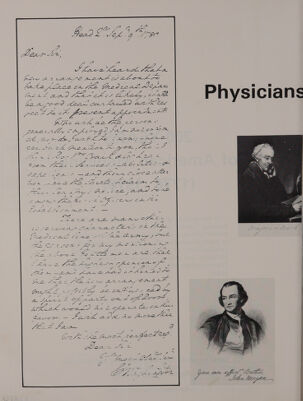
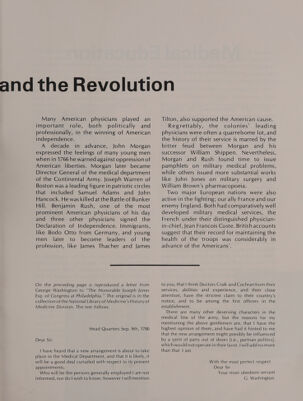
![Many American physicians played an important role, both politically and professionally, in the winning of American independence. A decade in advance, John Morgan expressed the feelings of many young men when in 1766 he warned against oppression of American liberties. Morgan later became Director General of the medical department of the Continental Army. Joseph Warren of Boston was a leading figure in patriotic circles that included Samuel Adams and John Hancock. He was killed at the Battle of Bunker Hill. Benjamin Rush, one of the most prominent American physicians of his day and three other physicians signed the Declaration of Independence. Immigrants, like Bodo Otto from Germany, and young men later to become leaders of the profession, like James Thacher and James On the preceding page is reproduced a letter from George Washington to “The Honorable Joseph Jones Esq. of Congress at Philadelphia.” The original is in the collection of the National Library of Medicine’s History of Medicine Division. The text follows. Head Quarters Sep. 9th, 1780 Dear Sir: | have heard that a new arrangement is about to take place in the Medical Department, and that it is likely, it will be a good deal curtailed with respect to its present appointments. Who will be the persons generally employed | am not informed, nor do! wish to know; however | will mention Tilton, also supported the American cause. Regrettably, the colonies’ leading physicians were often a quarrelsome lot, and the history of their service is marred by the bitter feud between Morgan and _ his successor William Shippen. Nevertheless, Morgan and Rush found time to issue pamphlets on military medical problems, while others issued more substantial works like John Jones on military surgery and William Brown’s pharmacopoeia. Two major European nations were also active in the fighting; our ally France and our enemy England. Both had comparatively well developed military medical services, the French under their distinguished physician- in-chief, Jean Francois Coste. British accounts suggest that their record for maintaining the health of the troops was considerably in advance of the Americans’. to you, that | think Doctors Craik and Cochran from their services, abilities and experience, and their close attention, have the strictest claim to their country’s notice, and to be among the first officers in the establishment. There are many other deserving characters in the medical line of the army, but the reasons for my mentioning the above gentlemen are, that | have the highest opinion of them, and have had it hinted to me that the new arrangement might possibly be influenced by a spirit of party out of doors [i.e., partisan politics], which would not operate in their favor. | willadd no more than that | am With the most perfect respect Dear Sir Your most obedient servant G. Washington](https://iiif.wellcomecollection.org/image/b32232056_0005.jp2/full/800%2C/0/default.jpg)