Volume 1
Quain's elements of anatomy / edited by Edward Albert Schäfer and George Dancer Thane.
- Date:
- 1895-1898
Licence: Public Domain Mark
Credit: Quain's elements of anatomy / edited by Edward Albert Schäfer and George Dancer Thane. Source: Wellcome Collection.
Provider: This material has been provided by King’s College London. The original may be consulted at King’s College London.
33/248 (page 25)
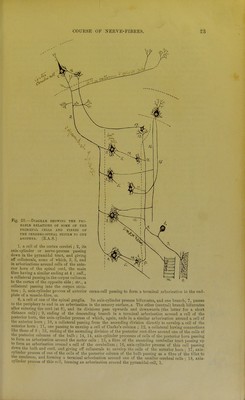
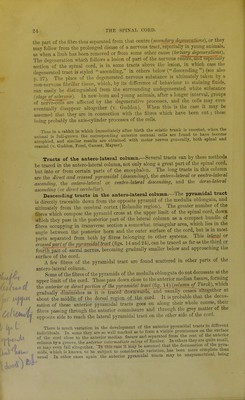
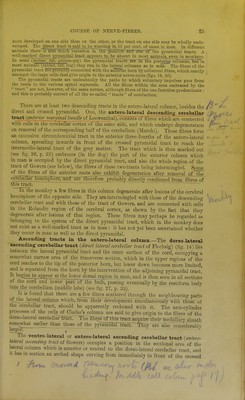
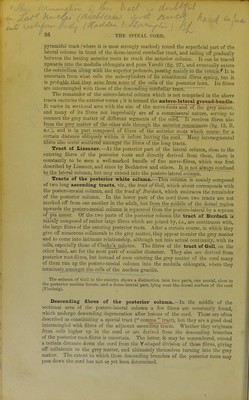
![more developed on one side than on the other, or the tract on one side may be wholly unde- veloped. The dyxect^tract is said to be wanting in 15 per cent, of cases in man. In different animals there isalso'much Variation in the'p6sT£ibn-aTrd'■gte6oFthe pyramidal tracts. A, well-marked _dii'ect pyramidal ti-act appears to be absent in most animals, even in monkeys. ■ In some (mous'eT rat, guinea-pig:) the pyramidal tracts are in the posterifijr columns, butin most animals (rabbit, catrdog) they run in the lateral columns as in man. The fibres of the pyramidal tract are probably connected with the anterior horn by collateral fibres, which ramify amongst the large cells that give origin to the anterior nerve-roots (figs. 16, 20). The pyramidal tracts are undoubtedly the paths by which voluntary impulses pass from the brain to the various spinal segments. AU the fibres within the area embraced by the tract are not, however, of the same nature, although fibres of the one function predominate : and this is probably correct of all the so-called tracts of conduction. There are at least two descending tracts in the antero-lateral column, besides the ^ ' ^ direct and crossed pyramidal. One, the antero-lateral descending cerebellar ^J^' jrl, tract {anterior marginal lundle of Loewenthal), consists of fibres which are connected f^J^ with cells in the cerebellar cortex of the same side, and which undergo degeneration on removal of the corresponding half of the cerebellum (Marchi). These fibres form an extensive circumferential tract in the anterior three-fourths of the antero-lateral : column, spreading inwards in front of the crossed pyramidal tract to reach the intermedio-lateral tract of the grey matter. The tract which is thus marked out (see fig. 26, p. 32) embraces (in the dog) the part of the anterior column which in man is occupied by the direct pyramidal tract, and also the whole region of the tract of Gowers (see below), the fibres of these two tracts being intermingled. Some of the fibres of the anterior roots also exhibit degeneration after removal of the cerebellaFhemisphere, and are therefore probably directly continued from fibres of tE]stract. Inlhe monkey a few fibres in this column degenerate after lesions of the cerebral hemisphere of the opposite side. They are intermingled with those of the descending V/rv/*'^1 cerebellar tract and with those of the tract of Gowers, and are connected with cells ' in the Eolandic region of the cerebral cortex, as shown by the fact that they degenerate after lesions of that region. These fibres may perhaps be regarded as belonging to the system of the direct pyramidal tract, which in the monkey does not exist as a well-marked tract as in man : it has not yet been ascertained whether they occur in man as well as the direct pyramidal. Ascending tracts in the antero-lateral column.—The dorso-lateral ascending cerebeUar tract {direct lateral cerebellar tract of Flechsig) (fig. 14) lies between the lateral pyramidal tract and the outer surface of the cord, occupying a somewhat narrow area of the transverse section, which in the upper regions of the cord reaches to the tip of the posterior horn, but lower down becomes more limited, and is separated from the horn by the intervention of the adjoining pyramidal tract. It begins to appear at thejower dorsal region in man, and is then seen in all sections of the cord and lower part~of the bulb, passing eventually by the restiform body into the cerebellum (middle lobe) (see fig. 27, p. 33). It is found that there are afew fibres scattered through the neighbouring parts of the lateral column which, from Their 'development simultaneously with those' of the cerebellar tract, should be apparently reckoned with it. The axis-cylinder processes of the cellsof_01arke's column are said to give origin to the fibres of the dorso-lateral cerebeUarlract. ' The fibres of this tract acquire their medullary sheath somewhat earlier than those of the pyramidal tract. They are also considerably larger. ' , The ventre-lateral or antero-lateral ascending cerebellar tract {antero- Uit&ral axcending tract of Gowers) occupies a position in the sectional area of the ■ lateral column which is anterior or ventral to the dorso-lateral cerebellar tract and It has m section an arched shape curving from immediately in front of the crossed](https://iiif.wellcomecollection.org/image/b21294021_0001_0033.jp2/full/800%2C/0/default.jpg)