The natural history of Selborne. Observations on various parts of nature : and The naturalist's calendar / by the late Rev. Gilbert White ; with notes, by Captain Thomas Brown.
- Gilbert White
- Date:
- 1833
Licence: Public Domain Mark
Credit: The natural history of Selborne. Observations on various parts of nature : and The naturalist's calendar / by the late Rev. Gilbert White ; with notes, by Captain Thomas Brown. Source: Wellcome Collection.
29/396 page 5
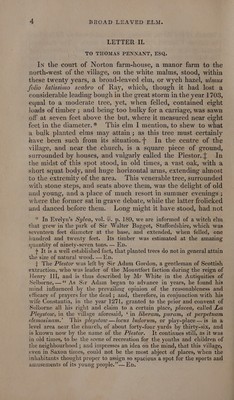
![the amazing tempest in 1703 overturned it at once, to the infinite regret of the inhabitants, and the vicar, who bestowed several pounds in setting it in its place again ; but all his care could not avail; the tree sprouted for a time, then withered and died. * This oak I mention, to shew to what a bulk planted oaks also may arrive; and planted this tree must certainly have been, as appears from what is known concerning the antiquities of the village. On the Blackmoor estate there is a small wood, called Losel’s, of a few acres, that was lately furnished with a set of oaks of a peculiar growth and great value : they were tall and taper like firs, but, standing near together, had very small heads — only * It is very probable that this great oak was planted, in the year 127], by the prior mentioned in the preceding note ; so that it must have been four hundred and thirty-two years old when blown down. — Ep. + The Shire Oak, so named from its peculiar local situation, standing on a spot where the counties of Derby, Nottingham, and York join, is one of the largest in the kingdom. ‘The area which it covers is seven hundred and seven square yards. In February, 1828, an ash tree was felled in Blackburn Hollows, near Shires Green, Yorkshire, contaiming seven hundred and fifty feet of solid timber: it was ten feet six inches across the stool. An oak was also felled in Shining Cliff, near Crich, Derbyshire, containing nine hundred and sixty-five feet, and was thirteen feet four inches across the stool. One of the most gigantic and venerable trees of this species is the celebrated Cowthorpe Oak, which stands on the extremity of the village of that name, near Wetherby, county of York. The late Dr Hunter, while describing an oak of extraordinary size, which decorates Sheffield Park, notices this majestic production of nature, in his edition of Evelyn’s Sylva, in the following terms: — “¢ Neither this, nor any of the oaks mentioned by Mr Evelyn, bears any proportion to one now growing at Cowthorpe. The dimensions are almost incredible. Within three feet of the ground it measures sixteen yards, and close to the ground twenty-six yards. Its height, in its present ruinous state, (1776, ) is almost eighty-five feet, and its principal limb extends sixteen yards from the bole. Throughout the whole tree the foliage is extremely thin; so that the anatomy of the ancient branches may be distinctly seen in the height of summer. When compared to this, all other trees are but children of the forest.” — Book i. p. 500. The description here given answers as nearly as possible to the present condition of the tree, as may be seen by comparing it with the accom- panying cut. The common oak is the quercus robur of botanists. The girth of our largest forest trees sinks into comparative insignifi- cance, when contrasted with that of some which are to be met with in the equinoctial regions of America. Mr Exter, in 1827, measured a cypress tree in the churchyard of Santa Maria de Tesla, two leagues and a half west of Oaxaca, whose trunk was one hundred and twenty-seven English feet in circumference, and one hundred and twenty feet in height, It appeared in the prime of its growth, and had nota single dead branch. — Ep.](https://iiif.wellcomecollection.org/image/b33094378_0029.jp2/full/800%2C/0/default.jpg)