Physical chemistry for beginners / by Dr. C.M. Van Deventer ; with a preface by J.H. Van 'T Hoff ; translated by R.A. Lehfeldt, D.Sc.
- Van Deventer, Ch. M.
- Date:
- [1897]
Licence: Public Domain Mark
Credit: Physical chemistry for beginners / by Dr. C.M. Van Deventer ; with a preface by J.H. Van 'T Hoff ; translated by R.A. Lehfeldt, D.Sc. Source: Wellcome Collection.
Provider: This material has been provided by University of Bristol Library. The original may be consulted at University of Bristol Library.
162/180 page 142
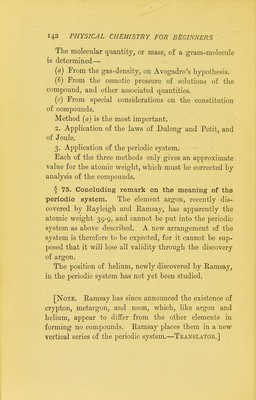
![The molecular quantity^ or mass, of a gram-molecule is determined— [a) From the gas-density, on Avogadro's hypothesis. {b) From the osmotic pressure of solutions of the compound, and other associated quantities. [c] From special considerations on the constitution of compounds. Method [a) is the most important. a. Application of the laws of Dulong and Petit, and of Joule. 3. Application of the periodic system. Each of the three methods only gives an approximate value for the atomic weight, which must be corrected by analysis of the compounds. § 75. Concluding remark on the meaning of the periodic system. The element argon, recently dis- covered by Rayleigh and Ramsay, has apparently the atomic weight 39*9, and cannot be put into the periodic system as above described. A new arrangement of the system is therefore to be expected, for it cannot be sup- posed that it will lose all validity through the discovery of argon. The position of helium, newly discovered by Ramsay, in the periodic system has not yet been studied. [Note. Ramsay has since announced the existence of crypton, metargon, and neon, which, like argon and helium, appear to differ from the other elements in forming no compounds. Ramsay places them in a new vertical series of the periodic system.—Translator.]](https://iiif.wellcomecollection.org/image/b21443695_0162.jp2/full/800%2C/0/default.jpg)