[Report 1951] / School Medical Officer of Health, Exeter.
- Exeter (England). City Council
- Date:
- 1951
Licence: Attribution 4.0 International (CC BY 4.0)
Credit: [Report 1951] / School Medical Officer of Health, Exeter. Source: Wellcome Collection.
63/116 (page 57)
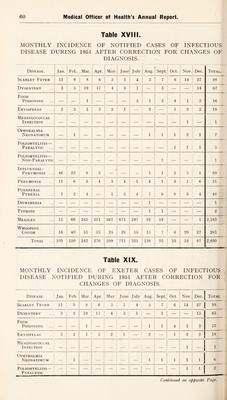
![contempt. Following them up (by the Assistant M.O.H. and Non-Medical Supervisor of Midwives as appropriate), however, involves a good deal of enquiry, and sometimes is apt to be mis- interpreted. There is no requirement in the regulations that the believed cause of the pyrexia shall be inserted by the general practitioner—a single extension which would enormously increase the value of the notification. Up to July 31st there were 15 notifications (including 6 home confinement cases) and attributed to the following causes—pelvic cause 5, breast engorgement 2, respirator}^ 2, urinary 1, others 2, unknown 3. From August 1st (under the new Regulations) 34 were notified. Of these 11 would have been notifiable under the old Regulations, and of these eleven, 3 were home confinement cases. The following table (Table XX) which sets out the causes attributed in the cases notified and also where the confinement took p]ace also shews the effect of the new regulations. Table XX, Puerperal Pyrexia, 1951. Cases N OTIFIED. Cases notifiable if old Regulations were still in force. Causes. | i All cases—old and new' regulations. (Jan. to Dec.) | Old Regulations New Regulations Jan. 1st.— Aug. 1st.— Aug. 1st.— i Confinement at : July 31st. Dec. 31st. Dec. 31st. Home. Hospital. 5 8 7 Uterine or Pelvic 2 11 2 8 i Breasts 1 9 (engorgement-mastitis) 9 4 it Respiratory 1 5 i 9 Urinary 1 9 2 i — Other causes 1 2 3 4 ~ Unknown o d 4 15 34 u 9 40 Total 49 49 It will be understood that complicated cases generally enter hospital so it must be expected that the pyrexia rate will be greater in hospital than at home.](https://iiif.wellcomecollection.org/image/b29199293_0065.jp2/full/800%2C/0/default.jpg)