Types of mankind or, Ethnological researches : based upon the ancient monuments, paintings, sculptures, and crania of races, and upon their natural, geographical, philological and Biblical history, illustrated by selections from the inedited papers of Samuel George Morton and by additional contributions from L. Agassiz; W. Usher; and H. S. Patterson / by J. C. Nott, and Geo. R. Gliddon.
- Josiah C. Nott
- Date:
- 1854
Licence: Public Domain Mark
Credit: Types of mankind or, Ethnological researches : based upon the ancient monuments, paintings, sculptures, and crania of races, and upon their natural, geographical, philological and Biblical history, illustrated by selections from the inedited papers of Samuel George Morton and by additional contributions from L. Agassiz; W. Usher; and H. S. Patterson / by J. C. Nott, and Geo. R. Gliddon. Source: Wellcome Collection.
Provider: This material has been provided by The University of Leeds Library. The original may be consulted at The University of Leeds Library.
758/796 (page 706)
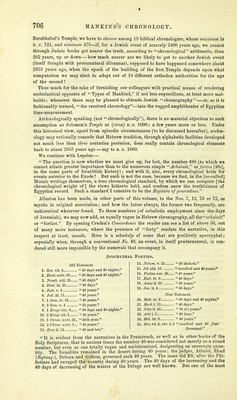
![* 706 mankind's chronology. Zerubbabel's Temple, we have to choose among 19 biblical chronologers, whose maximum is b. c. 741, and minimum 479—if, for a Jewish event of scarcely 2400 years ago, we cannot through Judaic books get nearer the truth, according to chronological arithmetic, than 262 years, up or down — how much nearer are we likely to get to another Jewish event (itself fraught with preternatural dilemmas), supposed to have happened somewhere about 2853 years ago, when the epoch of the building of the first Temple depends upon what computation we may elect to adopt out of 19 different orthodox authorities for the age of the second? Thus much for the sake of furnishing our colleagues with practical means of rendering ecclesiastical opposers of Types of Mankind, if not less supercilious, at least more mal- leable; whenever these maybe pleased to obtrude Jewish chronography — or, as it is fashionably termed, the received chronology—into the rugged amphitheatre of Egyptian time-measurement. Archaaologically speaking (not chronologically), there is no material objection to such assumption as Solomon's Temple at (circa) b. c. 1000; a few years more or less. Under this historical view, apart from episodic circumstances (to be discussed hereafter), archae- ology may rationally concede that Hebrew tradition, through alphabetic facilities developed not much less than three centuries posterior, does really contain chronological elements back to about 2853 years ago — say to b. c. 1000. We continue with Lepsius — The question is now whether we must give up, for lost, the number 480 (to which we cannot attach greater importance than to the numerous simple Arba'inat, or forties [40s], in the same parts of Israelitish history); and with it, also, every chronological helm for •events anterior to the Exode? But such is not the case, because we find, in the [so-called] Mosaic writings themselves, a true chronological standard, by which we can compute [the chronological weight of] the views hitherto held, and confirm anew the truthfulness of Egyptian record. Such a standard I conceive to be the Registers of generations. Allusion has been made, in other parts of this volume, to the Nos. 7, 12, 70 or 72, as mystic in original association; and how the latter always, the former two frequently, are unhistorical wherever found. To these numbers (of cabalistic employment since the days of Jeremiah), we may now add, as equally vague in Hebrew chronography, all the arba'inat or forties. By opening Cruden's Concordance the reader can see a list of above 50, out of many more instances, where the presence of forty renders the narrative, in this respect at least, unsafe. Here is a schedule of some that are positively apocryphal; especially when, through a conventional No. 40, an event, in itself prseternatural, is ren- dered still more impossible by the numerals that accompany it. Apocryphal Forties. Old Testament. 1. Gen. vii. 4 40 days and 40 nights. 2. Exod. xxiv.18 40 days and 40 nights. 3. Numb. xiii. 25 40 days. 4. Deut. ix. 25 40 days. 5. Josh. v. 6 40 years. 6. Jud. iii. 11 40 years. 7. 1 Sam. iv. 18 40 years. 8. 2 Sam. v. 4 40 years. 9. 1 Kings xix. 8 40 days and 40 nights. 10. 2 Kings xii. 1 40 years. 11. 1 Chron. xxvi. 31, 40th year. 12. 2 Chron. xxiy. 1... 40 years. 13. Ezra ii. 24 40 and two. 14. Nehem. v. 15 40 shekels. 15. Job xlii. 16 hundred and 40 years. 16. Psalms xcv. 10 40 years. 17. Ezek. iv. 6 40 days. 18. Amos ii. 10 40 years. 19. Jon. ii. 4 40 days. New Testament. 20. Matt. iv. 2 40 days and 40 nights. 21. Mark i. 13 40 days. 22. John ii. 30 40 six years. 23. Acts i. 3 40 days. 24. Heb. iii. 9 40 years. 25. Rev.yii.i, xiv. 1,3 hundred and 40 four thousand. It is evident from the narratives in the Pentateuch, as well as in other books of the Holy Scriptures, that in ancient times the number 40 was considered not merely as a round number, but even as one totally vague and undetermined, designating an uncertain quan- tity. The Israelites remained in the desert during 40 years; the judges, Athniel, Ehud (Septuag.), Debora and Gideon, governed each 40 years. The same did Eli, after the Phi- listines had ravaged the country during 40 years. The 40 days of the increasing and the 40 days of decreasing of the waters of the Deluge are well known. But one of the most](https://iiif.wellcomecollection.org/image/b21510404_0760.jp2/full/800%2C/0/default.jpg)