The diagnostic signs of incompetence of the pulmonary valve / by G. A. Gibson.
- Gibson George Alexander, 1854-1913.
- Date:
- 1894
Licence: Public Domain Mark
Credit: The diagnostic signs of incompetence of the pulmonary valve / by G. A. Gibson. Source: Wellcome Collection.
Provider: This material has been provided by the Royal College of Physicians of Edinburgh. The original may be consulted at the Royal College of Physicians of Edinburgh.
13/26 page 327
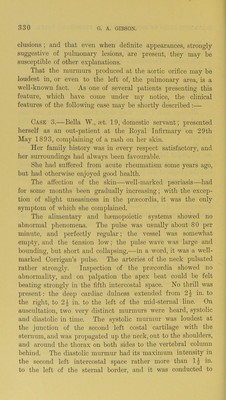
![murmur propagated into the axilla, and also, but to a less degree, towards the sternum. At the base a rough systolic was followed by a softer, although still somewhat harsh, diastolic murmur. Both of these murmurs were heard over the whole of the upper part of the chest, but their maximum intensity was to the left of the sternum, in the neighbourhood of the third costal cartilage. The diastolic murmur, in particular, had its point of maximum loudness in the third left inter- costal space, about an inch to the left of the external edge. The systolic murmur was distinctly propagated by the carotid arteries. The respiratory system showed symptoms and physical signs of hydrothorax and oedema of the lungs. The urine was scanty, and contained albumin. The patient had almost complete paralysis of the right leg and arm, with weakness of the facial muscles of the right side, and on the same side there was a considerable degree of wasting of the muscles, with contracture. In this case the original clinical features were to a great extent modified by the obvious failure of the cardiac muscle. It could not be doubted that there was a double lesion at the mitral orifice, producing stenosis and mcompetence. It was clear also that there was aortic stenosis, and very probably incompetence as well. But, as has been noted, the maximum intensity of the diastolic, as also of the systolic murmur, was to the left of the left sternal border, which fact, taken along with the clubbing of the fingers and toes, together with the Ijrofound respiratory disturbance, caused some doubt whether there might not be some lesion of the pulmonary valve or orifice. The conclusion arrived at, however, was that, in consequence of the backward pressure resulting from the mitral lesion, the clubbing of the fingers had resulted, while the combined effect of the mitral and aortic affections had been to cause the serious condition of cardiac failure. In spite of all treatment, the state of the patient became gi’adually worse, and she died somewhat suddenly on the 12th July. The post-mortem examination was performed on the 14th July by Dr. ]\Iuir, whose notes, for which my thanks are also due to Mr. Stuart Gallie, are appended.](https://iiif.wellcomecollection.org/image/b21713388_0013.jp2/full/800%2C/0/default.jpg)




 No text description is available for this image
 No text description is available for this image
 No text description is available for this image