Volume 1
The use of new medical technologies within the NHS : fifth report of session 2004-05 / House of Commons, Health Committee.
- Great Britain. Parliament. House of Commons. Health Committee
- Date:
- 2005
Licence: Open Government Licence
Credit: The use of new medical technologies within the NHS : fifth report of session 2004-05 / House of Commons, Health Committee. Source: Wellcome Collection.
26/36 (page 22)
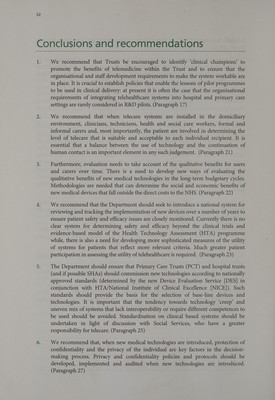
![We recommend that Trusts be encouraged to identify ‘clinical champions’ to promote the benefits of telemedicine within the Trust and to ensure that the organisational and staff development requirements to make the system workable are in place. It is crucial to establish policies that enable the lessons of pilot programmes to be used in clinical delivery: at present it is often the case that the organisational requirements of integrating telehealthcare systems into hospital and primary care settings are rarely considered in R&D pilots. (Paragraph 17) We recommend that when telecare systems are installed in the domiciliary environment, clinicians, technicians, health and social care workers, formal and informal carers and, most importantly, the patient are involved in determining the level of telecare that is suitable and acceptable to each individual recipient. It is essential that a balance between the use of technology and the continuation of human contact is an important element in any such judgement. (Paragraph 21) Furthermore, evaluation needs to take account of the qualitative benefits for users and carers over time. There is a need to develop new ways of evaluating the qualitative benefits of new medical technologies in the long-term budgetary cycles. Methodologies are needed that can determine the social and economic benefits of new medical devices that fall outside the direct costs to the NHS. (Paragraph 22) We recommend that the Department should seek to introduce a national system for reviewing and tracking the implementation of new devices over a number of years to ensure patient safety and efficacy issues are closely monitored. Currently there is no clear system for determining safety and efficacy beyond the clinical trials and evidence-based model of the Health Technology Assessment (HTA) programme while, there is also a need for developing more sophisticated measures of the utility of systems for patients that reflect more relevant criteria. Much greater patient participation in assessing the utility of telehealthcare is required. (Paragraph 23) The Department should ensure that Primary Care Trusts (PCT) and hospital trusts (and if possible SHAs) should commission new technologies according to nationally approved standards (determined by the new Device Evaluation Service [DES] in conjunction with HTA/National Institute of Clinical Excellence [NICE]). Such standards should provide the basis for the selection of base-line devices and technologies. It is important that the tendency towards technology ‘creep’ and uneven mix of systems that lack interoperability or require different competences to be used should be avoided. Standardisation on clinical based systems should be undertaken in light of discussion with Social Services, who have a greater responsibility for telecare. (Paragraph 25) We recommend that, when new medical technologies are introduced, protection of confidentiality and the privacy of the individual are key factors in the decision- making process. Privacy and confidentiality policies and protocols should be developed, implemented and audited when new technologies are introduced. (Paragraph 27)](https://iiif.wellcomecollection.org/image/b32221423_0001_0026.jp2/full/800%2C/0/default.jpg)