The venous and liver pulses, and the arhythmic contraction of the cardiac cavities / by James Mackenzie.
- James Mackenzie
- Date:
- 1894
Licence: Public Domain Mark
Credit: The venous and liver pulses, and the arhythmic contraction of the cardiac cavities / by James Mackenzie. Source: Wellcome Collection.
Provider: This material has been provided by Royal College of Physicians, London. The original may be consulted at Royal College of Physicians, London.
140/158 (page 134)
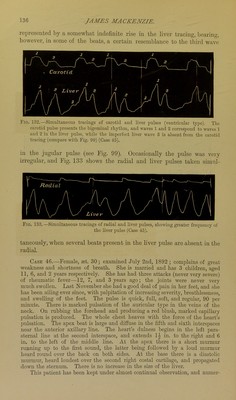
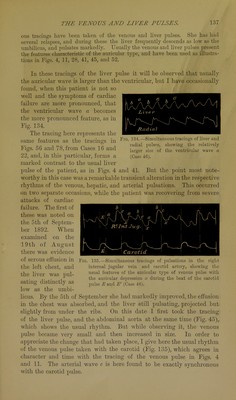
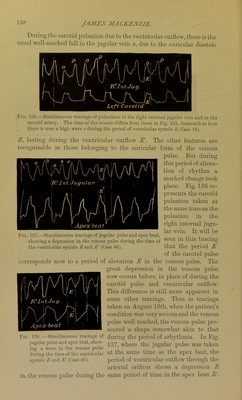
![lieard at the apex and in the axilla, and another of a different pitch heard over the lower part of the sternum. At the apex there is also heard a murmur during the diastole, hut it does not run up to the first sound, and it is not heard at the base. The abdomen is distended; the liver dul- ness extends 2 in. below the ribs, and pulsates distinctly (Fig. 128). The percussion note else- where over the abdomen is resonant, but fluctuation can he detected. Since the first examination the patient’s condition has undergone varying phases—sometimes improving, sometimes relapsing. Numerous observa- tions have been made, and a great number of tracings taken of liver and venous pulses, with the apex heat, carotid, and radial pulses, and the same features have been present throughout as are manifested in Figs. 127, 128, and 129. The pulse was always irregular, often markedly bigeminal, and the venous Fig. 128.—Simultaneous tracings of radial and liver pulses (ventricular type) (Case 44). Fig. 129.—Simultaneous tracings of carotid and jugular pulses during bigeminal action of the heart, showing the agreement in rhythm of the arterial and venous pulsations (Case 44). and liver pulsations always occurred rhythmically Avith the arterial pulse, as in Fig. 129. The peculiarity in this ease is a little wave always present in the venous pulse, sometimes not very distinct in the liver pulse, which piA- cecles the main elevation. It has a quasi-resemblance to a small auricular wave, but if accurately timed it always agrees with the carotid Fig. 130.—Simultaneous tracings of carotid and jugular pulses, showing con-espondence in rhythm, but longer duration of the venous pulse Avave (Case 44). pulse in time (Fig. 130). The beginning of the larger wave succeednig this does not correspond to the closure of the pulmonary valves, nor is there ever any indication of the presence of this event. I presume that ]iere, on account of the great distension of the venous system, as already](https://iiif.wellcomecollection.org/image/b28035781_0140.jp2/full/800%2C/0/default.jpg)