The London dispensatory, containing: I, the elements of pharmacy; II, the botanical description ... and medicinal properties, of the substances of the materia medica; III, the pharmaceutical preparations and compositions of the pharmacopoeias of the London, Edinburgh, and Dublin Colleges of Physicians / By Anthony Todd Thomson.
- Anthony Todd Thomson
- Date:
- 1836
Licence: Public Domain Mark
Credit: The London dispensatory, containing: I, the elements of pharmacy; II, the botanical description ... and medicinal properties, of the substances of the materia medica; III, the pharmaceutical preparations and compositions of the pharmacopoeias of the London, Edinburgh, and Dublin Colleges of Physicians / By Anthony Todd Thomson. Source: Wellcome Collection.
86/1132 page 66
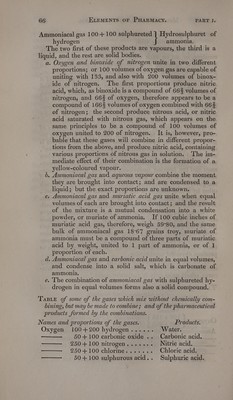
![Ammoniacal gas 100+ 100 sulphureted ] Hydrosulphuret of hydrogen ammonia, The two first of these products are vapours, the third is a liquid, and the rest are solid bodies. a. Oxygen and binoxide of nitrogen unite in two different proportions; or 100 volumes of oxygen gas are capable of uniting with 133, and also with 200 volumes of binox- ide of nitrogen. ‘The first proportions produce nitric acid, which, as binoxide is a compound of 664 volumes of nitrogen, and 663 of oxygen, therefore appears to be a compound of 166% volumes of oxygen combined with 664 of nitrogen; the second produce nitrous acid, or nitric acid saturated with nitrous gas, which appears on the same principles to be a compound of 100 volumes of oxygen united to 200 of nitrogen. It is, however, pro- bable that these gases will combine in different propor- tions from the above, and produce nitric acid, containing various proportions of nitrous gas in solution. ‘The im- mediate effect of their combination is the formation of a yellow-coloured vapour. Ammoniacal gas and aqueous vapour combine the moment they are brought into contact; and are condensed to a liquid; but the exact proportions are unknown. Ammoniacal gas and muriatic acid gas unite when equal volumes of each are brought into contact; and the result of the mixture is a mutual condensation into a white powder, or muriate of ammonia. If 100 cubic inches of muriatic acid gas, therefore, weigh 59°80, and the same bulk of ammoniacal gas 18°67 grains troy, muriate of ammonia must be a compound of three parts of muriatic acid by weight, united to 1 part of ammonia, or of 1 proportion of each. d. Ammoniacal gas and carbonic acid unite in equal volumes, and condense into a solid salt, which is carbonate of ammonia. e. ‘The combination of ammoniacal gas with sulphureted hy- drogen in equal volumes forms also a solid compound. Be € TaBie of some of the gases which mix without chemically com- bining, but may be made to combine; and of the pharmaceutical products formed by the combinations. Names and proportions of the gases. Products. Oxygen 100+200 hydrogen...... Water. 50+100 carbonic oxide .. Carbonic acid. 250+100 nitrogen....... Nitric acid. 250+100 chlorine....... Chloric acid. 50+ 100 sulphurous acid.. Sulphuric acid.](https://iiif.wellcomecollection.org/image/b29336995_0086.jp2/full/800%2C/0/default.jpg)


 No text description is available for this image
 No text description is available for this image
 No text description is available for this image