A treatise on physiology and hygiene : for schools, families, and colleges / by J.C. Dalton.
- John Call Dalton
- Date:
- 1868
Licence: Public Domain Mark
Credit: A treatise on physiology and hygiene : for schools, families, and colleges / by J.C. Dalton. Source: Wellcome Collection.
Provider: This material has been provided by the Francis A. Countway Library of Medicine, through the Medical Heritage Library. The original may be consulted at the Francis A. Countway Library of Medicine, Harvard Medical School.
350/420 page 344
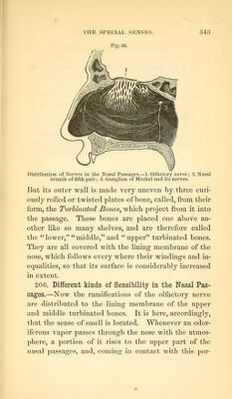
![tion of the lining membrane, gives us the sensation of its peculiar odor. The lower part of the nasal passages, on the contra- ry, have no sense of smell, but are supplied with other nervous fibres. A small branch of the fifth pair of nerves (Fig. 66 [2]) penetrates the side of the nostril high up, and then, running in a curved direction for- ward, downward, and backward, is distributed to the lining membrane of the lower turbinated bone and the adjacent parts. By this nerve the lower portions of the lining membrane are provided with ordinary sen- sibility. They can feel the contact of solid bodies, or of sharp and irritating vapors. Thus the passages of the nose are endowed, in their different parts, with two different kinds of sensibility. In their upper portions, by means of the olfactory nerves, they are provided with the special sensibility of smell, by which we perceive sweet and sour odors, and all the different varieties of perfume, which are so easily recognized, but which have received no definite name. In their lower portions, by means of the nasal branch of the fifth pair, they possess the power of ordi- nary sensibility, by which we perceive the contact of sharp audi pungent vapors, such as that of hartshorn or mustard. These pungent vapors are quite different in their nature from those which have an odoriferous quality. For the true odors, such as those of different flowers and the like, can only be perceived by the nose. But the pungent vapors are also irritating to other lin- ing membranes, such as those of the eyes and mouth, and even to the skin, if kept in contact with it long enough; only the lining membrane of the nose is more sensitive to them than the rest.](https://iiif.wellcomecollection.org/image/b21048332_0350.jp2/full/800%2C/0/default.jpg)