A treatise on physiology and hygiene : for schools, families, and colleges / by J.C. Dalton.
- John Call Dalton
- Date:
- 1868
Licence: Public Domain Mark
Credit: A treatise on physiology and hygiene : for schools, families, and colleges / by J.C. Dalton. Source: Wellcome Collection.
Provider: This material has been provided by the Francis A. Countway Library of Medicine, through the Medical Heritage Library. The original may be consulted at the Francis A. Countway Library of Medicine, Harvard Medical School.
351/420 page 345
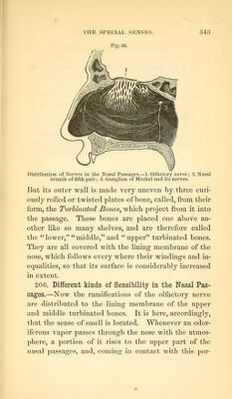
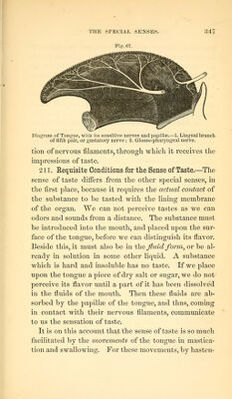
![Very often a real odor and a pungent vapor are ex- haled together from the same substance; as, for exam- ple, from mustard, from vinegar, or from Cologne water. But, in these cases, the odoriferous quality is always perceived by the upper part of the nasal passages, and the pungent or irritating quality by their lower part. 207. Sympathetic Nerves in the Nasal Passages.—The organ of smell is also supplied with nerves belonging to the sympathetic system. Immediately behind the posterior boundary of the nasal passages, and beneath the floor of the skull, is a small swelling of gray nerv- ous matter, called, from the name of its discoverer, the Ganglion of Meckel (Fig. 66 [3]). This ganglion is connected by slender filaments with the sympathetic plexus of the great blood-vessels of the head, and also with branches of the sensitive and motor cranial nerves. Its fibres are sent to the lining membrane of the nose, and also to the small muscles which lift the hanging palate, and thus guard the posterior opening of the na- sal passages. 208. Usefulness of the Sense of Smell.—The sense of smell is one of those which are possessed in much great- er perfection by some of the lower animals than by man. In the dog, the horse, the sheep, the deer, and many others, the nasal passages are much higher and deeper, the turbinated bones more extensively convo- luted, and the olfactory nerves themselves much larger and more sensitive. These animals .can therefore dis- tinguish odors which are entirely imperceptible to us. They can perceive the odors of other animals while at a distance and out of sight. The dog can even distin- guish between the odors of different persons, and will follow the track of his master through a crowd of other P 2](https://iiif.wellcomecollection.org/image/b21048332_0351.jp2/full/800%2C/0/default.jpg)