Sales catalogue 216: Pickering & Chatto
- Date:
- 20th century
- Reference:
- WA/HMM/CM/Sal/52/119
Licence: Public Domain Mark
Credit: Sales catalogue 216: Pickering & Chatto. Source: Wellcome Collection.
9/144 page 989
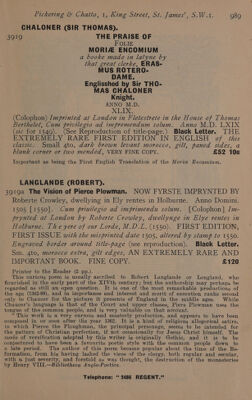
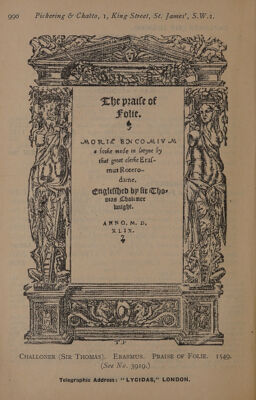
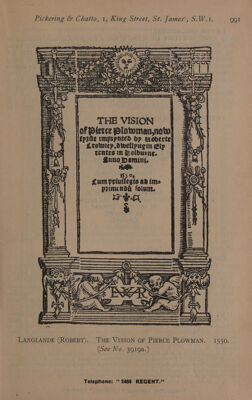
![CHALONER (SIR THOMAS). ROMO iy h THE PRAISE OF FOLIE MORIZ ENCOMIUM a booke made in latyne by that great clerke, ERAS= MUS ROTERO- DAME. Englisshed by Sir THO- MAS CHALONER Knight. ANNO M.D. : XLT. (Colophon) Imprznted at London in Fletestrete in the House of Thomas Berthelet, Cum privilegio ad impremendum solum. Anno M.D. LXIX (sec for 1540). (See Reproduction of title-page.) Black Letter. THE EXTREMELY RARE FIRST EDITION IN ENGLISH of this classic. Small 4to, dark brown levant morocco, gilt, paned sides, a blank corner or two mended, VERY FINE COPY. £52 10s Important as being the First Fnglish Translation of the Morie Encomium. LANGLANDE (ROBERT). | | 3919a The Vision of Pierce Plowman. NOW FYRSTE IMPRYNTED BY Roberte Crowley, dwellying in Ely rentes in Holburne. Anno Domini. 1505 [1550]. Cum priuilegio ad imprimendu solum. [Colophon] /m- prynted at London by Roberte Crowley, dwellynge in Elye rentes in Holburne. The yere of our Lorde, M.D.L. (1550). FIRST EDITION, FIRST ISSUE with the misprinted date 1505, altered by stamp to 1550. Engraved border around title-page (see reproduction). Black Letter. Sm. 4to, morocco extra, gilt edges, AN EXTREMELY RARE AND IMPORTANT BOOK. FINE COPY. £120 Printer to the Reader (2 pp.). This curious poem is usually ascribed to Robert Langlande or Longland, who flourished in’ the early part) of the XIVth century; but the authorship may perhaps be regarded as still an oper question. It is one of the most remarkable productions of the age (1362-80), and in importance and interest and merit of execution ranks second only to Chaucer for the picture it presents of England in the middle ages. While Chaucer’s language is that of the Court and upper classes, Piers Plowman useg the tongue of the common people, and is very valuable on that account. “This work is a very curious and masterly production, and appears to have been composed in or soon after the year 1362. It is a kind of religious allegorical satire, in which Pierce the Ploughman, the principal personage, seems to be intended for the pattern of Christian perfection, if not occasionally for Jesus Christ himself. The mode of versification adopted by this writer is originally Gothic, and it is to be conjectured to have been a favourite poetic style with the common people down to a late period. The author of this poem. became popular about the time of the Re- formation, from his having lashed the vices of the clergy, both regular and secular, with a just severity, and foretold as was thought, the destruction of the monasteries by Henry VIII.—Bibliotheca Angio-Poetica.](https://iiif.wellcomecollection.org/image/b33160053_0009.jp2/full/800%2C/0/default.jpg)

 No text description is available for this image
 No text description is available for this image
 No text description is available for this image