Disease of the mind : Notes on the early management, European and American progress, modern methods, etc. in the treatment of insanity, with especial reference to the needs of Massachusetts and the United States / by Charles F. Folsom.
- Charles Follen Folsom
- Date:
- 1877
Licence: Public Domain Mark
Credit: Disease of the mind : Notes on the early management, European and American progress, modern methods, etc. in the treatment of insanity, with especial reference to the needs of Massachusetts and the United States / by Charles F. Folsom. Source: Wellcome Collection.
Provider: This material has been provided by the Harvey Cushing/John Hay Whitney Medical Library at Yale University, through the Medical Heritage Library. The original may be consulted at the Harvey Cushing/John Hay Whitney Medical Library at Yale University.
45/142 page 33
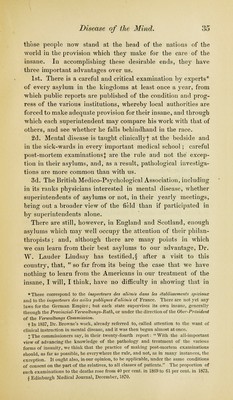
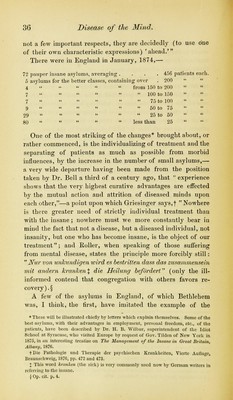
![In costly arrangements for convenience of administration, in the magnificence of their central or administrative buildings, and in the multiplicity of labor-saving machinery, where it is difficult to find enough for the patients to do, the new Amer- ican state hospitals for the insane are absolutely without rivals. Less than half a dozen* of our States are now providing properly for all their insane, the expensive buildings which have lately been thought necessary being absolutely beyond the means of many of them. The condition of our worst asylums may be inferred from the report for 1872 of one of our medical superintendents, who says :— In the appropriate tabular statement accompanying this report, there are several colored people reported as having died from various forms of disease. To have been strictly truthful, that report should have read, ' died from want of proper accommodations '; for I verily believe their lives might have been saved, if I could have had the proper facilities for their comfort and care at my command. Every one knows the inefficacy of medical attention in the treat- ment of diseases, where the patients are confined to such miserable cattle-stalls as are our colored patients. In 1871, a newly appointed superintendent in Texas found restraint-chairs, dark rooms, iron handcuffs, locked boxes, and cold shower- and plunge-baths in common use. He thought it necessary to state his opinion that the infliction of punishment for misconduct on the part of any patient is entirely out of place. The records and journal were not to be found. In 1876, chains were still used in the department for the insane of the almshouse at Baltimore. * Of all spectacles of human misery which the light of day looks upon, we sup- pose that of the lunatics in American almshouses is the most pitiable. Unlike many sufferers under the great evils of society, they are often persons who have been in better circumstances, and who mast, in their dim way, feel and see the abuses of their treatment. In the country poorhouses, they are treated as lunatics were a hundred years ago in Europe. They are chained, put in cages, beaten, kept in dark holes, without fire, often naked, their food reached to them as to beasts, their clothes seldom changed, without bedding, except straw, left in their own filth, and eaten by parasites. This horrible treatment was (till within three years) common in many of our States, and is still the fact in the majority. [The Nation, No. 660, New York, 1876.]](https://iiif.wellcomecollection.org/image/b21024558_0045.jp2/full/800%2C/0/default.jpg)
 No text description is available for this image
 No text description is available for this image
 No text description is available for this image