[Report 1959] / Medical Officer of Health and School Medical Officer of Health, East Riding of Yorkshire County Council.
- East Riding of Yorkshire (England). County Council
- Date:
- 1959
Licence: Attribution 4.0 International (CC BY 4.0)
Credit: [Report 1959] / Medical Officer of Health and School Medical Officer of Health, East Riding of Yorkshire County Council. Source: Wellcome Collection.
68/88 (page 60)
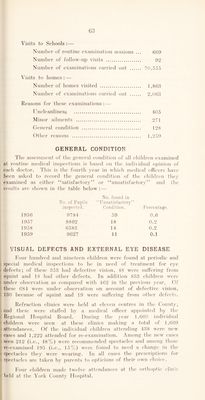
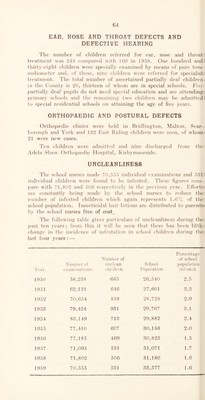
Ioyed. The Principal Dental Officer, Mi\ K. H. ('hamplin, resigned on the 31st October. One additional dental officer was appointed for part-time service on a sessional basis in the Haltempriee area but unfortunately this addition to the staff was balanced by the resignation of Mrs. K. M. Howard from the Bridlington area at the end of the year. In view of the continued shortage in dental staff the Iklucation Committee decided to reorganise the oj)eration of the school dental service in the Count} in an attempt to ensure that as many children as possible left school dentally fit. It was decided that the limited dental staff should concentrate as much as possible on the pupils in the secondary schools and endeavour to ])rovide annual treatment when necessary for all secondary school children in the course of the next six years. More details of this scheme are given in the Principal Dental Officer’s section of the report. Since August it has not been possible to provide speech therapy for any school children in the County as there have been no appli- cations for tbe three vacant posts of si>eech therapists which have existed since that date • d'here has been a substantial increase in the routine work carried out by the school medical officers in tbe County schools. This increase is shown in both routine inspections and special examina- tions, the total number being 4,278 more than last year. This increase in time spent on this work can be accounted for because less time has been given by the medical staff to carrying out poliomyelitis vaccinations. The health of the school children con- tinues to be most satisfactory and only 0.1% of children were considered to be in poor general condition when examined at routine or special examinations.](https://iiif.wellcomecollection.org/image/b29185671_0070.jp2/full/800%2C/0/default.jpg)