Elements of the philosophy of the human mind / by Dugald Stewart.
- Dugald Stewart
- Date:
- 1854
Licence: Public Domain Mark
Credit: Elements of the philosophy of the human mind / by Dugald Stewart. Source: Wellcome Collection.
Provider: This material has been provided by the National Library of Medicine (U.S.), through the Medical Heritage Library. The original may be consulted at the National Library of Medicine (U.S.)
18/510
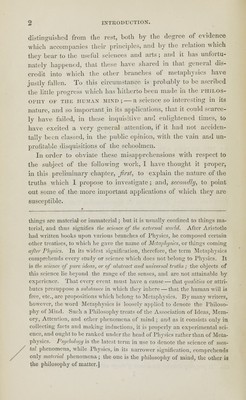
![distinguished from the rest, both by the degree of evidence which accompanies their principles, and by the relation which they bear to the useful sciences and arte; and it lias unfortu- nately happened, that these have shared in that general dis- credit into which the other branches of metaphysics have justly fallen. To this circumstance is probably to be ascribed the little progress which has hitherto been made in the philos- ophy of the HUMAN mind; — a science so interesting in its nature, and so important in its applications, that it could scarce- ly have failed, in these inquisitive and enlightened times, to have excited a very general attention, if it had not acciden- tally been classed, in the public opinion, with the vain and un- profitable disquisitions of the schoolmen. In order to obviate these misapprehensions with respect to the subject of the following work, I have thought it proper, in this preliminary chapter, first, to explain the nature of the truths which I propose to investigate; and, secondly, to point out some of the more important applications of which they are susceptible. things arc material or immaterial; but it is usually confined to things ma- terial, and thus signifies the science of the external world. After Aristotle had written books upon various branehes of Physics, he composed certain other treatises, to which he gave the name of Metaphysics, or things coming after Physics. In its widest signification, therefore, the term Metaphysics comprehends every study or science which does not belong to Physics. It is the science of jmre ideas, or of abstract and universal truths ; the objects of this science lie beyond the range of the senses, and are not attainable by experience. That every event must have a cause — that qualities or attri- butes presuppose a substance in which they inhere — that the human will is free, etc., arc propositions which belong to Metaphysics. By many writers, however, the word Metaphysics is loosely applied to denote the Philoso- phy of Mind. Such a Philosophy treats of the Association of Ideas, Mem- ory, Attention, and other phenomena of mind ; and as it consists only in collecting facts and making inductions, it is properly an experimental sci- ence, and ought to be ranked under the head of Physics rather than of Meta- physics. Psychology is the latest term in use to denote the science of men- tal phenomena, while Physics, in its narrower signification, comprehends only material phenomena ; the one is the philosophy of mind, the other is the philosophy of matter.]](https://iiif.wellcomecollection.org/image/b21156657_0018.jp2/full/800%2C/0/default.jpg)


 No text description is available for this image
 No text description is available for this image
 No text description is available for this image