Elements of the philosophy of the human mind / by Dugald Stewart.
- Dugald Stewart
- Date:
- 1854
Licence: Public Domain Mark
Credit: Elements of the philosophy of the human mind / by Dugald Stewart. Source: Wellcome Collection.
Provider: This material has been provided by the National Library of Medicine (U.S.), through the Medical Heritage Library. The original may be consulted at the National Library of Medicine (U.S.)
9/510
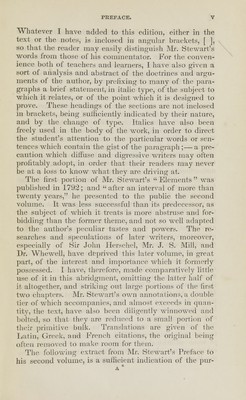
![Whatever I have added to this edition, either in the text or the notes, is inclosed in angular brackets, [ ], so that the reader may easily distinguish Mr. Stewart's words from those of his commentator. For the conven- ience both of teachers and learners, I have also given a sort of analysis and abstract of the doctrines and argu- ments of the author, by prefixing to many of the para- graphs a brief statement, in italic type, of the subject to which it relates, or of the point which it is designed to prove. These headings of the sections are not inclosed in brackets, being sufficiently indicated by their nature, and by the change of type. Italics have also been freely used in the body of the work, in order to direct the student's attention to the particular words or sen- tences which contain the gist of the paragraph ;— a pre- caution which diffuse and digressive writers may often profitably adopt, in order that their readers may never be at a loss to know what they are driving at. The first portion of Mr. Stewart's Elements was published in 1792; and after an interval of more than twenty years, he presented to the public the second volume. It was less successful than its predecessor, as the subject of which it treats is more abstruse and for- bidding than the former theme, and not so well adapted to the author's peculiar tastes and powers. The re- searches and speculations of later writers, moreover, especially of Sir John Herschel, Mr. J. S. Mill, and Dr. Whewell, have deprived this later volume, in great part, of the interest and importance which it formerly possessed. I have, therefore, made comparatively little use of it in this abridgment, omitting the latter half of it altogether, and striking out large portions of the first two chapters. Mr. Stewart's own annotations, a double tier of which accompanies, and almost exceeds in quan- tity, the text, have also been diligently winnowed and bolted, so that they are reduced to a small portion of their primitive bulk. Translations are given of the Latin, Greek, and French citations, the original being often removed to make room for them. The following extract from Mr. Stewart's Preface to his second volume, is a sufficient indication of the pur- A*](https://iiif.wellcomecollection.org/image/b21156657_0009.jp2/full/800%2C/0/default.jpg)