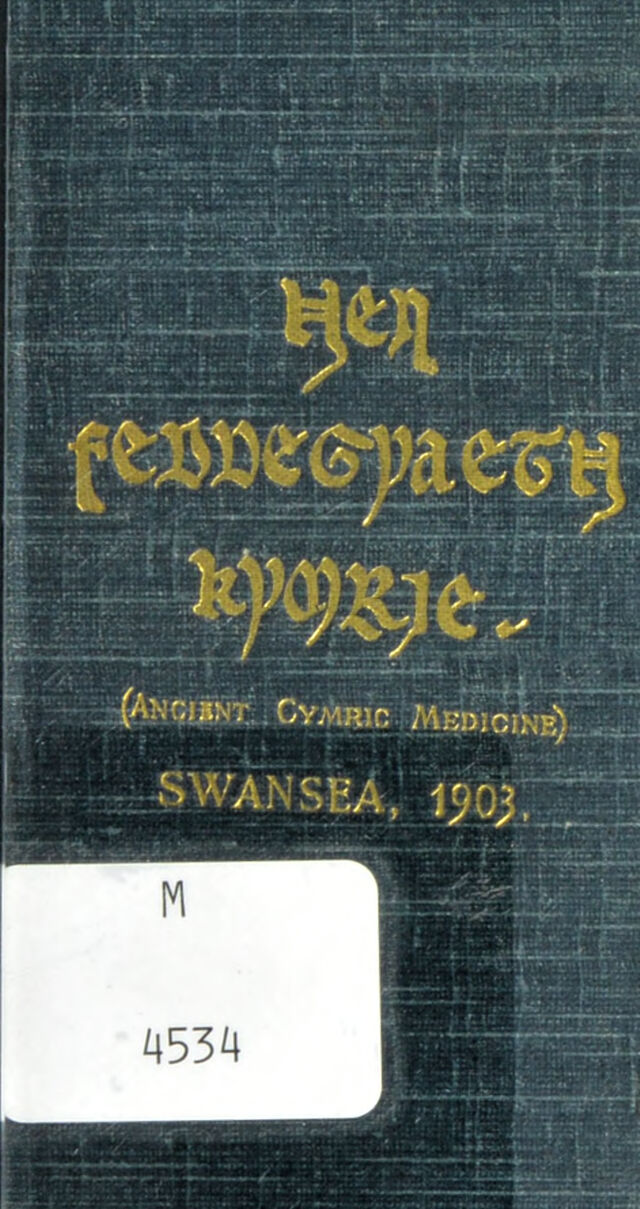
Hen feddegyaeth kymrie : (antient Cymric medicine) and lecture memoranda, British Medical Association meeting, Swansea, 1903.
- Date:
- [1903]
Licence: Attribution 4.0 International (CC BY 4.0)
Credit: Hen feddegyaeth kymrie : (antient Cymric medicine) and lecture memoranda, British Medical Association meeting, Swansea, 1903. Source: Wellcome Collection.
15/190 page 11
![During the reign of Pryclain, the Gwycldoniaicl became divided into three orders, which consisted of the Druids, the Bards, and the Ovates, each of which had its peculiar duties as well as privileges. The Druids were especially ])rolicient in mystic and religious rites, and medicine ; the Bards in oratory, poetry, and inu.sic; and the Ovates in natural sciences. “ . . . save when meditation Gives place to holy rites; then, in the grove. Each order has its rank and station.” As early as the year 430 n.c. (before the time of Hippocrate.s), there is evidence from the laws of Dy\Tiwal Moelmud, which were written about that period, that the art of medicine was protected and encouraged by the State. Therein medicine, commerce and navigation are called the three civil arts, each of which had a peculiar corporate privilege. This privilege is stated to have been “ by the grant and creation of the lord of the territory, authenticated by the judicature, and distinct from the general privileges of a country and kindred.” It is probable that the Druids and Ovates became pos.ses.sed of some .knowledge of Grecian medicine through the Plu'enicians, or the Etruscans, who traded with. Britain, for in later times the name of Hippocrates is mentioned, and his works were much esteemed by the physicians of Myddfai. The antiquity of the Druidic study of medicine is recorded by several of the early historians, and Strabo mentions that the Druids were acquainted with physiology. The system of medical treatment, apart from their superstitious rites, was distinctly](https://iiif.wellcomecollection.org/image/b29008682_0015.jp2/full/800%2C/0/default.jpg)