Hen feddegyaeth kymrie : (antient Cymric medicine) and lecture memoranda, British Medical Association meeting, Swansea, 1903.
- Date:
- [1903]
Licence: Attribution 4.0 International (CC BY 4.0)
Credit: Hen feddegyaeth kymrie : (antient Cymric medicine) and lecture memoranda, British Medical Association meeting, Swansea, 1903. Source: Wellcome Collection.
23/190 page 19
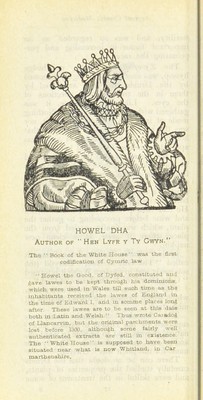
![diseases, but how far their medical know- ledge extended there is little evidence to show. Horlase asserts that they had a knowledge of anatomy, and demonstrated on the bodies of living men ; but no evi- dence in proof of this statement has been produced. Leaving the druidical period, the next historic reference to early Cymric medicine is made by Taliesin, who was “Chief of the Bards” in the 6th century. This eminent chieftain was learned in medicine and physiology. He wrote of the tx)dy:—“There are three intractable sub.stantial organs—the liver, the kidney and the heart. There are three intractable membranes—the dura mater, the peri- toneum, and the urinary bladder. There are three tedious complaints—di,sea.se of the knee joints, disease of the substance of a rib, and ])hthisis, for when purulent matter has formed in one of these, it is not known when it will get well.” Between the sixth and the tenth centuries, little is known of the condition of medicine in Wales, for the country was torn by feuds and wars until the time of Ilowel Dha, named Howel the Good, who lived about 930 A.D. This monarch prescribed a code of laws, in which some very interest- ing references are made to the practitioner of medicine of that period. One of the laws deals with the office and privileges of a mediciner or physician to the Royal Court, with an account of his rluties and fees. The court physician or mediciner was granted free land and a horse, and was also entitled to receive his linen clothing >9](https://iiif.wellcomecollection.org/image/b29008682_0023.jp2/full/800%2C/0/default.jpg)