Human genetics : minutes of evidence, Wednesday 8 February 1995 ... / Science and Technology Committee.
- Great Britain. Parliament. House of Commons. Select Committee on Science and Technology
- Date:
- [1995], ©1995
Licence: Open Government Licence
Credit: Human genetics : minutes of evidence, Wednesday 8 February 1995 ... / Science and Technology Committee. Source: Wellcome Collection.
22/40 (page 92)
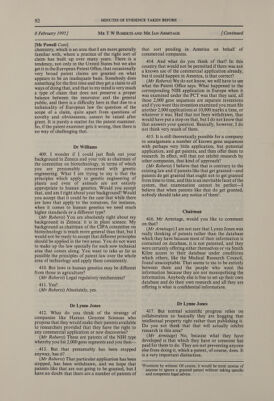
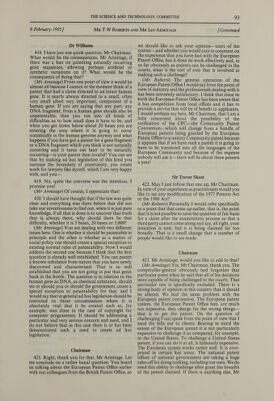
![8 February 1995] [ Continued [Mr Powell Cont] chemistry, which is an area that I am more generally familiar with, where a practice of the right sort of claim has built up over many years. There is a tendency, not only in the United States but we also get it in the European Patent Office, that occasionally very broad patent claims are granted on what appears to be an inadequate basis. Somebody does something for the first time and they get a claim to all ways of doing that, and that to my mind is very much a type of claim that does not preserve a proper balance between the innovator and the general public, and there is a difficulty here in that due to a technicality of European law the question of the scope of a claim, quite apart from questions of novelty and obviousness, cannot be raised after grant. It is purely a matter for the patent examiner. So, if the patent examiner gets it wrong, then there is no way of challenging that. Dr Williams 409. I wonder if I could just flesh out your background in Zeneca and your role as chairman of the committee on biotechnology, in terms of which you are presumably concerned with genetic engineering. What I am trying to say is that the principles which apply to genetic engineering of plants and even of animals are not entirely appropriate to human genetics. Would you accept that, and am I right about your background? Would you accept that it could be the case that while there are laws that apply to the tomatoes, for instance, when it comes to human genetics we need much higher standards or a different type? (Mr Roberts) You are absolutely right about my background in Zeneca: it is in plant science. My background as chairman of the CIPA committee on biotechnology is much more general than that, but I would not be ready to accept that different principles should be applied in the two areas. You do not want to make up the law specially for each new technical area that comes along. You want to take as far as possible the principles of patent law over the whole area of technology and apply them consistently. 410. But laws in human genetics may be different from those in agriculture? (Mr Roberts) Legal regulatory mechanisms? 411. Yes? (Mr Roberts) Absolutely, yes. Dr Lynne Jones 412. What do you think of the strategy of companies like Human Genome Sciences who propose that they would make their patents available to researchers provided that they have the right to any commercial application or new discoveries? (Mr Roberts) These are patents of the NIH type whereby you list 2,000 gene segments and you then— 413. But that presumably has been stopped anyway, has it? (Mr Roberts) That particular application has been stopped, has been withdrawn, and we hope that patents like that are not going to be granted, but I have no doubt that there are a number of patents of that sort pending in America on behalf of commercial companies. 414. And what do you think of that? In this country that would not be permitted if there was not a known use of the commercial application already, but it could happen in America, is that correct? (Mr Roberts) We do not know, we will have to see what the Patent Office says. What happened to the corresponding NIH application in Europe when it — was examined under the PCT was that they said, all these 2,000 gene sequences are separate inventions and if you want this invention examined you must file another 2,000 applications at 10,000 marks a time, or whatever it was. Had that not been withdrawn, that would have put a stop on that, but I do not know that that answers your question. Basically, however, I do not think very much of them. 415. It is still theoretically possible for a company to amalgamate a number of known gene sequences with perhaps very little application, but potential application, and get patents, and then offer them to research. In effect, will that not inhibit research by other companies, that kind of approach? (Mr Roberts) I believe that that is contrary to the existing law and if patents like that get granted—and patents do get granted that ought not to get granted from time to time, and this is an inevitable facet of the system, that examination cannot be perfect—I believe that when patents like that do get granted, nobody should take any notice of them!. Chairman 416. Mr Armitage, would you like to comment on that? (Mr Armitage) I am not sure that Lynne Jones was really thinking of patents rather than the database which they have because most of their information is contained on database, it is not patented, and they were certainly offering either themselves or via Smith Kline access to their database under conditions which others, like the Medical Research Council, found unacceptable. That seems to me to be entirely between them and the people who want the information because they are not monopolising the information. Anybody else is free to set up their own database and do their own research and all they are offering is what is confidential information. Dr Lynne Jones 417. But normal scientific progress relies on collaboration so basically they are hogging that intellectual property right rather than publishing it. © Do you not think that that will actually inhibit research in this area? (Mr Armitage) No, because what they have developed is that which they have or someone has paid for them to do. They are not preventing anyone else from doing it, which a patent, of course, does. It is a very important distinction. ‘Footnote by witness: Of course, it would be most unwise of anyone to ignore a granted patent without taking specific and competent legal advice.](https://iiif.wellcomecollection.org/image/b32230175_0022.jp2/full/800%2C/0/default.jpg)