Human genetics : minutes of evidence, Wednesday 8 February 1995 ... / Science and Technology Committee.
- Great Britain. Parliament. House of Commons. Select Committee on Science and Technology
- Date:
- [1995], ©1995
Licence: Open Government Licence
Credit: Human genetics : minutes of evidence, Wednesday 8 February 1995 ... / Science and Technology Committee. Source: Wellcome Collection.
5/40 (page 75)
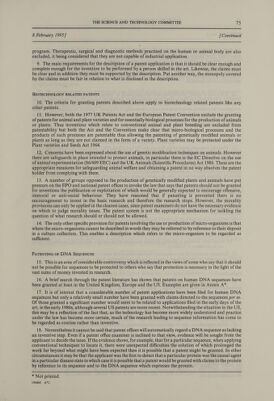
![8 February 1995] [ Continued program. Therapeutic, surgical and diagnostic methods practised on the human or animal body are also excluded, it being considered that they are not capable of industrial application. 9. The main requirements for the description of a patent application is that it should be clear enough and complete enough for the invention to be performed by a person skilled in the art. Likewise, the claims must be clear and in addition they must be supported by the description. Put another way, the monopoly covered by the claims must be fair in relation to what is disclosed in the description. BIOTECHNOLOGY RELATED PATENTS 10. The criteria for granting patents described above apply to biotechnology related patents like any other patents. 11. However, both the 1977 UK Patents Act and the European Patent Convention exclude the granting of patents for animal and plant varieties and for essentially biological processes for the production of animals or plants. Thus inventions which relate to conventional animal and plant breeding are excluded from patentability but both the Act and the Convention make clear that micro-biological processes and the products of such processes are patentable thus allowing the patenting of genetically modified animals or plants as long as they are not claimed in the form of a variety. Plant varieties may be protected under the Plant varieties and Seeds Act 1964. 12. Concerns have been expressed about the use of genetic modification techniques on animals. However there are safeguards in place intended to protect animals, in particular there is the EC Directive on the use of animal experimentation (86/609 EEC) and the UK Animals (Scientific Procedures) Act 1986. These are the appropriate measures for safeguarding animal welfare and obtaining a patent in no way absolves the patent holder from complying with them. 13. A number of groups opposed to the production of genetically modified plants and animals have put pressure on the EPO and national patent offices to invoke the law that says that patents should not be granted for inventions the publication or exploitation of which would be generally expected to encourage offensive, immoral or anti-social behaviour. They have reasoned that if patenting is prevented there is no encouragement to invest in the basic research and therefore the research stops. However, the morality provisions can only be applied in the clearest cases, since patent examiners do not have the necessary evidence on which to judge morality issues. The patent system is not the appropriate mechanism for tackling the question of what research should or should not be allowed. 14. The only other specific provision for patents involving the use or production of micro-organisms is that where the micro-organisms cannot be described in words they may be referred to by reference to their deposit in a culture collection. This enables a description which refers to the micro-organism to be regarded as sufficient. PATENTING OF DNA SEQUENCES 15. This is an area of considerable controversy which is reflected in the views of some who say that it should not be possible for sequences to be protected to others who say that protection is necessary in the light of the vast sums of money invested in research. 16. A brief search through the patent literature has shown that patents on human DNA sequences have been granted at least in the United Kingdom, Europe and the US. Examples are given in Annex A*. 17. It is of interest that a considerable number of patent applications have been filed for human DNA sequences but only a relatively small number have been granted with claims directed to the sequences per se. Of those granted a significant number would seem to be related to applications filed in the early days of the art, ie the early 1980s, although several US patents are more recent. Notwithstanding the situation in the US, this may be a reflection of the fact that, as the technology has become more widely understood and practice under the law has become more certain, much of the research leading to sequence information has come to be regarded as routine rather than inventive. 18. Neveretheless it cannot be said that patent offices will automatically regard a DNA sequence as lacking an inventive step. Even if a patent office examiner is inclined to that view, evidence will be sought from the applicant to decide the issue. If the evidence shows, for example, that for a particular sequence, when applying conventional techniques to locate it, there were unexpected difficulties the solution of which prolonged the work far beyond what might have been expected then it is possible that a patent might be granted. In other circumstances it may be that the applicant was the first to detect that a particular protein was the causal agent in a particular disease state in which case it is possible that a patent would be granted with claims to the protein by reference to its sequence and to the DNA sequence which expresses the protein. * Not printed. 194404 A*2](https://iiif.wellcomecollection.org/image/b32230175_0005.jp2/full/800%2C/0/default.jpg)