Human genetics : minutes of evidence, Wednesday 8 February 1995 ... / Science and Technology Committee.
- Great Britain. Parliament. House of Commons. Select Committee on Science and Technology
- Date:
- [1995], ©1995
Licence: Open Government Licence
Credit: Human genetics : minutes of evidence, Wednesday 8 February 1995 ... / Science and Technology Committee. Source: Wellcome Collection.
6/40 (page 76)
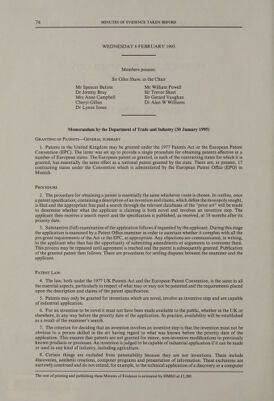
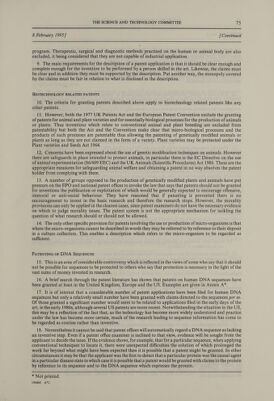
![8 February 1995] [Continued 19. An important distinction needs to be made between the patenting of sequences whose function is known and those sequences arising out of the human genome project whose function is not known. The National Institute of Health in the US attempted recently to obtain patents for the latter in the face of international condemnation and subsequently withdrew their application which had received a preliminary rejection from the US Patent and Trade Mark Office. Lack of inventive step was only one of a number of objections raised against the sequence claims and it is still far from clear which objection(s) against claims of this type could be sustained. 20. It is a fact of patent examination that each case has to be treated on its merits and this is no less the situation in biotechnology than in other areas of technology. Parliament has laid down the principles and the examiner has to apply these to each case. Patent Office decisions may be challenged in the High Court — either on appeal if the patent is refused or in revocation proceedings if the patent is granted. Examiners rely on these court judgments in shaping their approach to future applications. If it is considered that the court decisions do not have the desired result, it is open to Parliament to amend the law. The Patent Office cannot do this; it has to apply the law as it stands. COMPULSORY LICENCES 21. Since the commencement of the Patents Act 1977 on 1 June 1978, two compulsory licences have been ordered in the United Kingdom. Neither was for a invention in the biotechnology field — one was for a method of honing surfaces and the other for a conveyor system. 22. In view of the small sample, it is not possible to generalise on whether compulsory licences tend to be ordered for new products or for ones reaching the end of their patents life. In the first of the case mentioned above, the licence was ordered in 1981 ona patent having an application date in 1966. In the second case, the licence was granted in 1990 on a patent having an application date in 1976. 23. In accordance with the Paris Convention for the Protection of Industrial Property, the Patents Act permits compulsory licences only on patents which have been in force for at least three years. Apart from that, the Government does not have a policy on the number of compulsory licences, or the age of the patents on which they are granted. Compulsory licences are only granted in response to specific applications, which have to be justified in quasi-judicial proceedings before the Patent Office on the basis of criteria laid down in the Patents Act. 24. The main grounds for the grant of a Compulsory licence are: (a) failure to meet the demand in the UK on reasonable terms, (b) meeting the demand in the UK by importation from outside the European Economic area, (c) the efficient working of another patented invention which makes a substantial contribution to the art is prevented or hindered. 25. In future, the terms of any compulsory licences ordered will need to comply with the provisions of the GATT Agreement of Trade-Related Aspects of Intellectual Property Rights (Article 31). CROWN USE 26. The main area where use of patents is authorised is in Ministry of Defence (MOD) contracts. By custom and practice, such authorisation is given in a Standard Contract Condition 32A, which authorises use of patents for the purposes of the contract. The rationale behind this is:— (a) There should be minimal delay in fulfilling the contract (b) Contractors are expected to exclude from their prices any contingency element to allow for the possibility of patent infringement claims. This results is a net saving to the MOD as only relatively few contracts result in claims for compensation for use of patents. 27. Other departments tend to authorise use of patents on a case-by-case basis. Generally, they reserve authorisation for cases where:— (a) Patentees are unwilling or unable to meet an urgent demand (b) A patentee is unable technically to deliver a product embodying the invention. The availability of authorisation enables a Government department in effect to use first and settle later. This enables use to be made in situations where negotiation of a licence would take time and in situations where, under the Patents Act 1977, a compulsory licence would only be available three years after grant of the patent. If Crown Use did not exist, then in the very occasional problem or crisis situation it would be necessary to introduce emergency or other special legislation and this might itself delay necessary action in the relevant situation.](https://iiif.wellcomecollection.org/image/b32230175_0006.jp2/full/800%2C/0/default.jpg)