The bacteriology of the eye / by Theodor Axenfeld ; translated by Angus Macnab.
- Theodor Axenfeld
- Date:
- 1908
Licence: Public Domain Mark
Credit: The bacteriology of the eye / by Theodor Axenfeld ; translated by Angus Macnab. Source: Wellcome Collection.
54/438 page 36
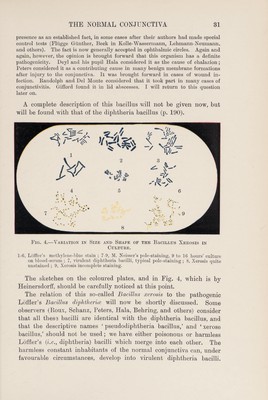
![I must further state that these cocci comparatively often show a haemolytic activity which, according to Max Neisser, is a peculiarity of the pathogenic cocci. Further research is necessary on this question.1 2 The following cocci should be considered identical with the Staphylococcus or Micrococcus albus2 (usually non-liquefaciens): Coccus albus non-liquefaciens (Fick). Staphylococcus albus non-liquefaciens (Eymowicz). Staphylococcus epidermidis albus (Morax, Griffith, Jackson, Lawson). [;Staphylococcus liabanensis (Santos-Fernandez) ?]. Micrococcus epidermidis albus (Randolph). Micrococcus albus non-liquefaciens (Fick). Staphylococcus brevis (Griffith), distinguished by the small size of the cocci. Diplococcus amplus (Gromakowski, Basso). Micrococcus candicans (Fick, Gombert, Marthen, Bernheim, Bach, Lachowicz, Dudzinski, Basso, Eymowicz). Further, the greater proportion of the organisms called Staphylococcus pyogenes albus by many authors, and the Trachoma cocci (Michel, Kucharsky, Sattler, Goldschmidt, Staderini, Poncet, Petresco, Lawson), whose more exact description agrees essentially with the Micrococcus albus. On account of the morphological similarity which these cocci, in secretion films, can show to the Gonococcus, I have named them Gram-positive Pseudo-gonococci, easily distinguishable by Gram’s stain. This name is also used by Uhthoff, Brecht, and others, with the same significance. The name does not signify that the organism is a variety of the Gonococcus. At a later date I have used this name for the Gram¬ negative Diplococci resembling Gonococci, naturally merely to signify that these are morphologically similar Diplococci, which, however, cannot be considered as Gonococci. Amongst the Gram-positive Pseudo-gonococci the Micr. albus and its allies take the most important place ; it is exceedingly rare for pyogenic cocci to present this double appearance so thoroughly as does the albus. The following occasional varieties are closely related, and, like the white cocci, have a low pathogenic value : Staphylococcus cereus albus3 (Santos, Fernandez, Basso). Micrococcus cereus albus (Lachowicz).3 Diplococcus albicans (Gromakowski). Diplococcus albicans tardus (Basso). Diplococcus albicans tardissimus4 (Basso). 1 Bossalino succeeded by passage through animals in exalting the virulence of an aureus, which was low when obtained from the conjunctival sac of a rabbit operated for cataract. Rupprecht has commenced a similar attempt with the common albus in my own laboratory, and has sometimes had definite exaltation. 2 In the lists by Brandt and Rosenthal, where the majority of the organisms here quoted will be found, they are erroneously arranged as different species, some as pathogenic, others as non-pathogenic. This variety, recorded by Passet, and characterized by a waxy gloss, thick growth, slow development, and no liquefaction of gelatine, was considered as pyogenic by Günther. It is not so in the same sense as is aureus, and it is not pathogenic for animals. 4 Abelsdorff and Neumann identify their Gram-negative Diplococci with this organism. The single statement of Bumm that the Diplococcus tardissimus is Gram-negative, on which Abelsdorff and Neumann base their diagnosis, cannot, however, be allowed.](https://iiif.wellcomecollection.org/image/b31353563_0054.jp2/full/800%2C/0/default.jpg)


 No text description is available for this image
 No text description is available for this image
 No text description is available for this image