A view of the philosophical principles of phrenology / by J. Spurzheim.
- Johann Spurzheim
- Date:
- 1825
Licence: Public Domain Mark
Credit: A view of the philosophical principles of phrenology / by J. Spurzheim. Source: Wellcome Collection.
Provider: This material has been provided by The University of Leeds Library. The original may be consulted at The University of Leeds Library.
96/232 page 84
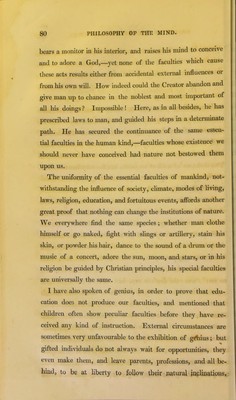
![has its own organ, in proportion to whose development are its manifestations. Now in childhood several organs are very little, and in adult age very greatly developed; and Avhile some are proportionately larger in children than in the grown-up, others are fully developed in both. The manifestations of the faculties being, as I have stated, always proportionate to the development and activity of their organs, it becomes evident why some of them do not appear in infancy. Why moral principles differ in different nations is also obvious. I agree with Locke that they are not innate, but maintain that the faculties which form them are. I shall afterwards show that moral principles depend on several facul- ties, and vary in nations in consequence of different combi- nations of their organs ; the justice of a libertine without be- nevolence and veneration must differ entirely from that of a charitable, modest, and continent person. The same funda- mental faculties exist everywhere, but their manifestations are universally modified. Men everywhere adore a Supreme Being; they everywhere have marks of honour and of infamy; there are everywhere masters and servants; all nations make war, whether with clubs and arrows, or with muskets and artillery ; and everywhere the dead are lamented, and their remembrance cherished, whether it be by embalming their bodies, by putting their ashes into an urn, or by depositing their remains in the tomb. Hence, though the functions of the faculties in general are modified in different nations, and of those consequently which determine the moral principles also, the same fundamental powers] still appear in the cus- toms, manners, and laws of all.](https://iiif.wellcomecollection.org/image/b21521505_0096.jp2/full/800%2C/0/default.jpg)



 No text description is available for this image
 No text description is available for this image
 No text description is available for this image