[Report 1941] / Medical Officer of Health, Cumberland County Council.
- Cumberland County Council
- Date:
- 1941
Licence: Attribution 4.0 International (CC BY 4.0)
Credit: [Report 1941] / Medical Officer of Health, Cumberland County Council. Source: Wellcome Collection.
32/50 page 32
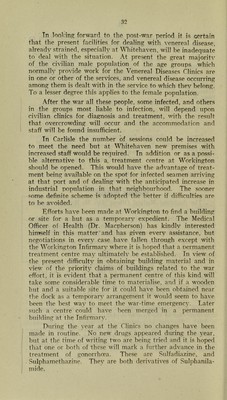
![Tn looking forward to the post-war period it is certain that the present facilities for dealing with venereal disease, already strained, especially at Whitehaven, will be inadequate to deal with the situation. At present the great majoritv of the civilian male population of the age groups which normally provide work for the Venereal Diseases Clinics are in one or other of the services, and venereal disease occurring among them is dealt with in the service to which they belong. To a lesser degree this applies to the female population. After the war all these people, some infected, and others in the groups most liable to infection, will depend upon civilian clinics for diagnosis and treatment, v’ith the result that overcrowding will occur and the accommodation and staff will be found insufficient. Tn Carlisle the number of sessions could be increased to meet the need but at Whitehaven new premises with increased staff would be required. Tn addition or as a possi- ble alternative to this a treatment centre at Workington should be opened. This would have the advantage of treat- ment being available on the spot for infected seamen arriving at that port and of dealing with the anticipated increase in industrial population in that neighbourhood. The sooner some definite scheme is adopted the better if difficulties are to be avoided. Efforts have been made at Workington to find a building or site for a hut as a temporarv expedient. The Medical Officer of Health (Dr. Macpherson) has kindly interested hinTself in this matter and has given every assistance, but negotiations in every case have fallen through except with the Workington Tnfirmary where it is hoped that a nermanent treatment centre may ultimatelv be established. Tn view of the present difficulty in obtaining building material and in view of the priority claims of buildings related to the war effort, it is evident that a permanent centre of this kind will take some considerable time to materialise, and if a wooden hut and a suitable site for it could have been obtained near the dock as a temporary arrangement it would seem to have been the best wav to meet the war-time emergency. Later such a centre could have been merged in a permanent building at the Tnfirmary. During the year at the Clinics no changes have been made in routine. No new drugs ap]ieared during the year, but at the time of writing two are being tried and it is hoped that one or both of these will mark a further advance in the treatment of gonorrhoea. These are Sulfadiazine, and Sulphamethazine. They are both derivatives of Sulphanila- nu‘de,](https://iiif.wellcomecollection.org/image/b29132976_0034.jp2/full/800%2C/0/default.jpg)