Volume 1
Formal gardens in England and Scotland : their planning and arrangement, architectural and ornamental features / by H. Inigo Triggs ; illustrated by seventy-two plates from drawings by the author and fifty three reproduced from photographs by Charles Latham.
- Inigo Triggs
- Date:
- 1902
Licence: Public Domain Mark
Credit: Formal gardens in England and Scotland : their planning and arrangement, architectural and ornamental features / by H. Inigo Triggs ; illustrated by seventy-two plates from drawings by the author and fifty three reproduced from photographs by Charles Latham. Source: Wellcome Collection.
16/104 page 2
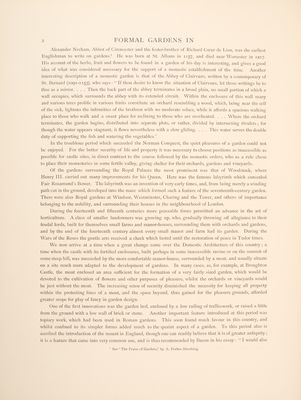
![Alexander Necham, Abbot of Cirencester and the foster-brother of Richard Coeur de Lion, was the earliest Englishman to write on gardens. He was born at St. Albans in 1157, and died near Worcester in i207 His account of the herbs, fruit and flowers to be found in a garden of his day is interesting, and gives a good idea of what was considered necessary for the support of a monastic establishment of the time. Another interesting description of a monastic garden is that of the Abbey of Clairvaux, written by a contemporary of St. Bernard (1091-1153), who says: “‘ If thou desire to know the situation of Clairvaux, let those writings be to thee as a mirror. . . . Then the back part of the abbey terminates in a broad plain, no small portion of which a wall occupies, which surrounds the abbey with its extended circuit. Within the enclosure of this wall many and various trees prolific in various fruits constitute an orchard resembling a wood, which, being near the cell of the sick, lightens the infirmities of the brethren with no moderate solace, while it affords a spacious walking place to those who walk and a sweet place for reclining to those who are overheated. . . . Where the orchard terminates, the garden begins, distributed into separate plots, or rather, divided by intersecting rivulets ; for though the water appears stagnant, it flows nevertheless with a slow gliding. . . . This water serves the double duty of supporting the fish and watering the vegetables.” In the troublous period which succeeded the Norman Conquest, the quiet pleasures of a garden could not be enjoyed. For the better security of life and property it was necessary to choose positions as inaccessible as possible for castle sites, in direct contrast to the course followed by the monastic orders, who as a rule chose to place their monasteries in some fertile valley, giving shelter for their orchards, gardens and vineyards. Of the gardens surrounding the Royal Palaces the most prominent was that of Woodstock, where Henry II]. carried out many improvements for his Queen. Here was the famous labyrinth which concealed Fair Rosamund’s Bower. ‘The labyrinth was an invention of very early times, and, from being merely a winding path cut in the ground, developed into the maze which formed such a feature of the seventeenth-century garden. There were also Royal gardens at Windsor, Westminster, Charing and the Tower, and others of importance belonging to the nobility, and surrounding their houses in the neighbourhood of London. During the fourteenth and fifteenth centuries more peaceable times permitted an advance in the art of horticulture. A class of smaller landowners was growing up, who, gradually throwing off allegiance to their feudal lords, built for themselves small farms and manor-houses, surrounding them with orchards and gardens, and by the end of the fourteenth century almost every small manor and farm had its garden. During the Wars of the Roses the gentle arts received a check which lasted until the restoration of peace in Tudor times. We now arrive at a time when a great change came over the Domestic Architecture of this country; a time when the castle with its fortified enclosures, built perhaps in some inaccessible ravine or on the summit of some Steep hill, was succeeded by the more comfortable manor-house, surrounded by a moat, and usually situate on a site much more adapted to the development of gardens. In many cases, as, for example, at Broughton Castle, the moat enclosed an area sufficient for the formation of a very fairly sized garden, which would be devoted to the cultivation of flowers and other purposes of pleasure, whilst the orchards or vineyards would be just without the moat. The increasing sense of security diminished the necessity for keeping all property within the protecting lines of a moat, and the space beyond, thus gained for the pleasure grounds, afforded greater scope for play of fancy in garden design. One of the first innovations was the garden bed, enclosed by a low railing of trellis-work, or raised a little from the ground with a low wall of brick or stone. Another important feature introduced at this period was topiary work, which had been used in Roman gardens. This soon found much favour in this country, and whilst confined to its simpler forms added much to the quaint aspect of a garden. To this period also 1s ascribed the introduction of the mount in England, though one can readily believe that it is of greater antiquity ; it is a feature that came into very common use, and is thus recommended by Bacon in his essay: “I would also —oec Ihe Praise ot Gardens, by A. Porbes sieveking.](https://iiif.wellcomecollection.org/image/b31359504_0001_0016.jp2/full/800%2C/0/default.jpg)
 No text description is available for this image
 No text description is available for this image
 No text description is available for this image