The laws of heredity : their definite meaning and interpretation / editor: Henry Smith Williams, M.D., LL.D.
- Date:
- [1914]
Licence: Public Domain Mark
Credit: The laws of heredity : their definite meaning and interpretation / editor: Henry Smith Williams, M.D., LL.D. Source: Wellcome Collection.
4/32 page 2
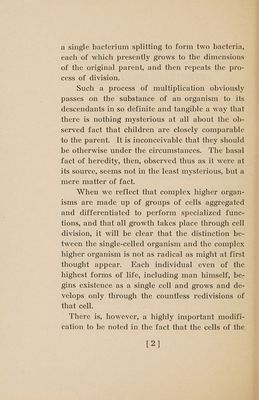
![a single bacterium splitting to form two bacteria, each of which presently grows to the dimensions of the original parent, and then repeats the pro- cess of division. Such a process of multiplication obviously passes on the substance of an organism to its descendants in so definite and tangible a way that there is nothing mysterious at all about the ob- served fact that children are closely comparable to the parent. It is inconceivable that they should be otherwise under the circumstances. The basal fact of heredity, then, observed thus as it were at its source, seems not in the least mysterious, but a mere matter of fact. When we reflect that complex higher organ- isms are made up of groups of cells aggregated and differentiated to perform specialized func- tions, and that all growth takes place through cell division, it will be clear that the distinction be- tween the single-celled organism and the complex higher organism is not as radical as might at first thought appear. Each individual even of the highest forms of life, including man himself, be- gins existence as a single cell and grows and de- velops only through the countless redivisions of that cell. ; There is, however, a highly important modifi- cation to be noted in the fact that the cells of the [2] aoe:](https://iiif.wellcomecollection.org/image/b33628415_0004.jp2/full/800%2C/0/default.jpg)