o- and p-Toluenazoglyoxalines / by Frank Lee Pyman and Leonard Allan Ravald.
- Pyman, Frank Lee.
- Date:
- [1920?]
Licence: In copyright
Credit: o- and p-Toluenazoglyoxalines / by Frank Lee Pyman and Leonard Allan Ravald. Source: Wellcome Collection.
2/8 page 1427
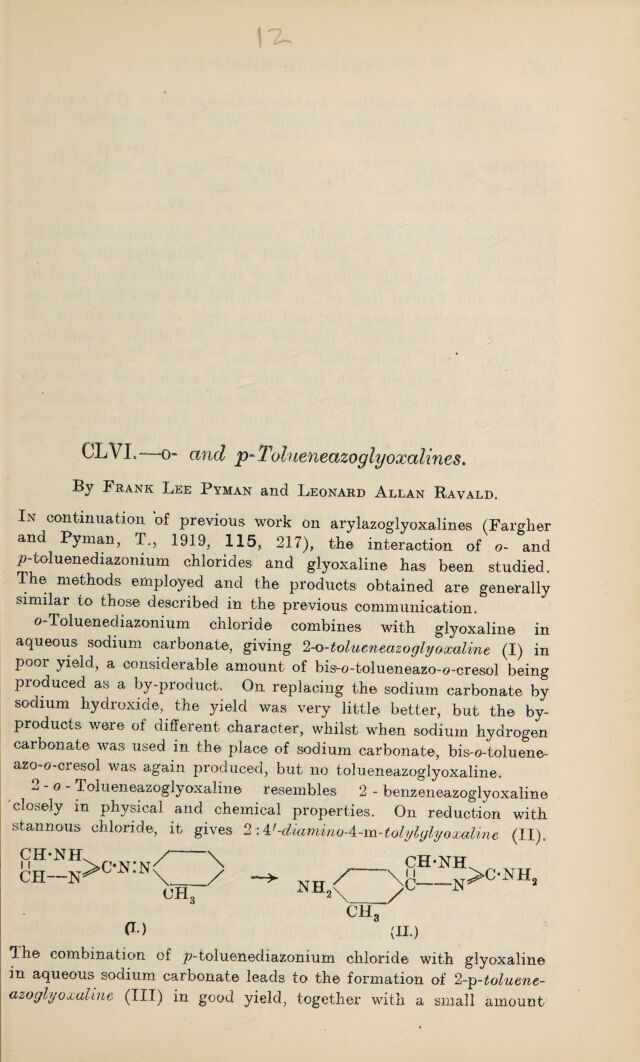
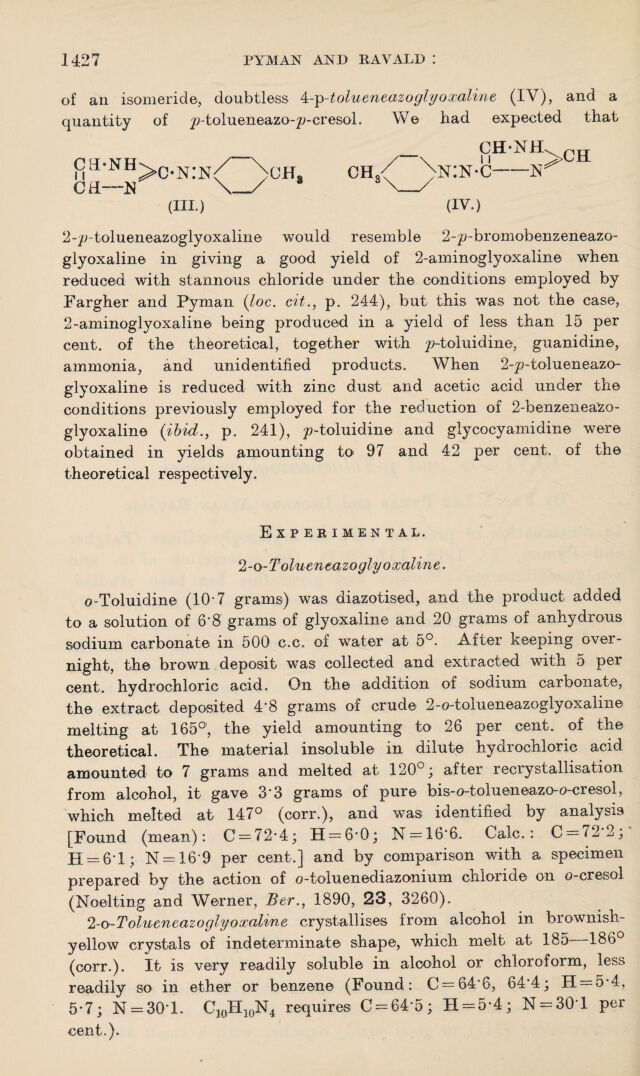
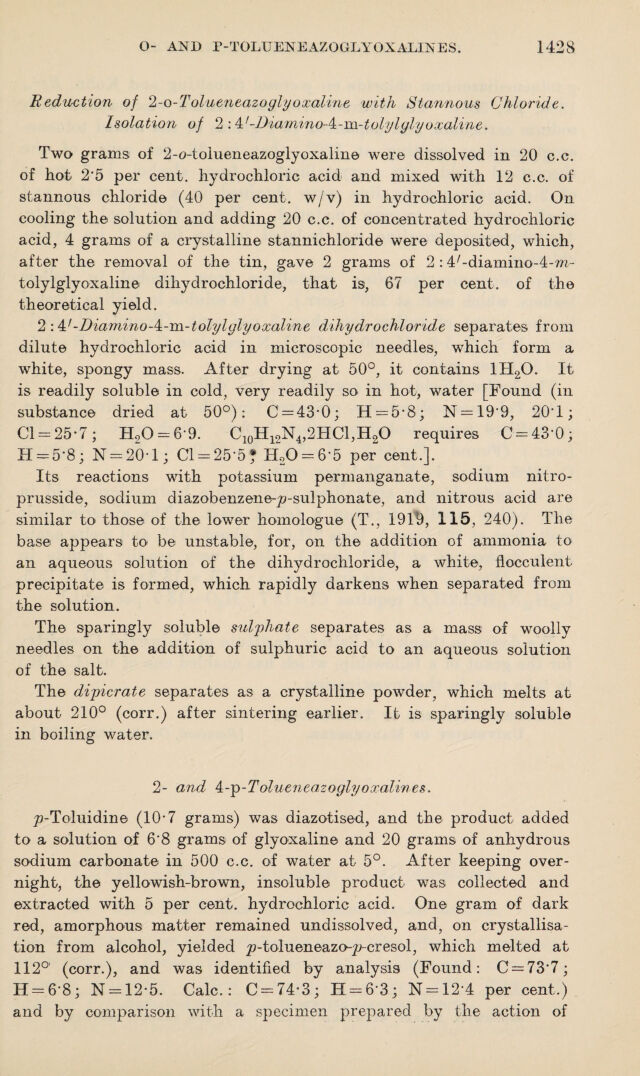
![of an isomeride, doubtless 4-p-tolueneazoglyoxaline (IV), and a quantity of ^-tolueneazo-^-cresol. We had expected that mH,NH>C-N:N CE—N (III.) CH CH-NH -N >CH (IV.) 2-p-tolueneazoglyoxaline would resemble 2-p-bromobenzeneazo- glyoxaline in giving a good yield of 2-ammoglyoxaline when reduced with stannous chloride under the conditions employed by Fargher and Pyman (loc. cit., p. 244), but this was not the case, 2-aminoglyoxaline being produced in a yield of less than 15 per cent, of the theoretical, together with ^-toluidine, guanidine, ammonia, and unidentified products. When 2-p-tolueneazo- glyoxaline is reduced with zinc dust and acetic acid under the conditions previously employed for the reduction of 2-benzeneaZo- glyoxalin© (ibid., p. 241), y-toluidine and glycocyamidine were obtained in yields amounting to 97 and 42 per cent, of the theoretical respectively. Experimental. 2-o-Tolueneazoglyoxaline. o-Toluidine (10'7 grams) was diazotised, and the product added to a solution of 6*8 grams of glyoxaline and 20 grams of anhydrous sodium carbonate in 500 c.c. of water at 5°. After keeping over¬ night, the brown deposit was collected and extracted with 5 per cent, hydrochloric acid. On the addition of sodium carbonate, the extract deposited 4*8 grams of crude 2-o-tolueneazoglyoxaline melting at 165°, the yield amounting to 26 per cent, of the theoretical. The material insoluble in dilute hydrochloric acid amounted to 7 grams and melted at 120°; after recrystallisation from alcohol, it gave 3'3 grams of pure bis-o-tolueneazo-o-cresol, which melted at 147° (corr.), and was identified by analysis [Found (mean): C = 72*4; H = 6*0; N = 16'6. Calc.: C = 7^2; H — 61; N = 16'9 per cent.] and by comparison with a specimen prepared by the action of o-toluenediazonium chloride on o-cresol (Noelting and Werner, Ber., 1890, 23, 3260). 2-o-Tolueneazoglyoxaline crystallises from alcohol in brownish- yellow crystals of indeterminate shape, which melt at 185 186° (corr.). It is very readily soluble in alcohol or chloroform, less readily so in ether or benzene (Found: C = 646, 64'4; 11 = 5*4, 5*7; N = 301. C10FI10N4 requires C = 64*5 ; H = 5*4; N = 30*l per cent.).](https://iiif.wellcomecollection.org/image/b30622633_0002.jp2/full/800%2C/0/default.jpg)


 No text description is available for this image
 No text description is available for this image
 No text description is available for this image