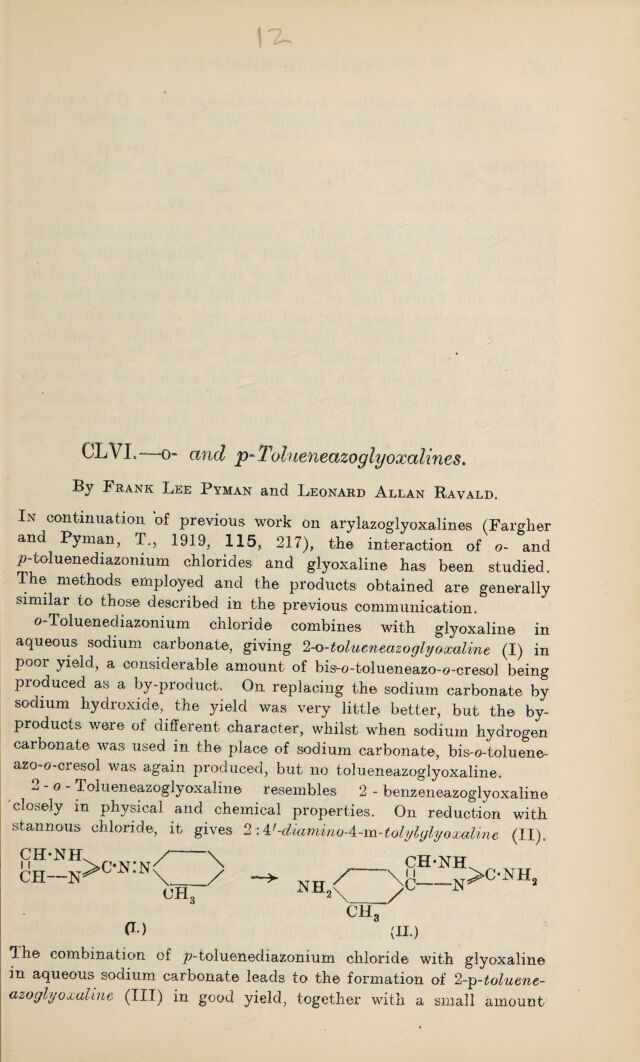
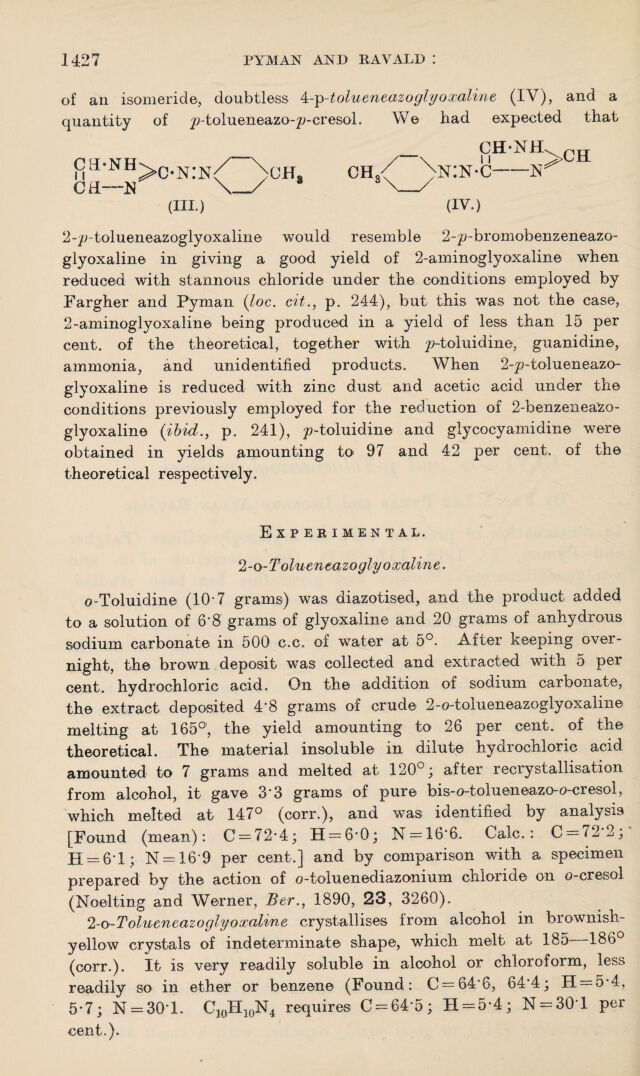
o- and p-Toluenazoglyoxalines / by Frank Lee Pyman and Leonard Allan Ravald.
- Pyman, Frank Lee.
- Date:
- [1920?]
Licence: In copyright
Credit: o- and p-Toluenazoglyoxalines / by Frank Lee Pyman and Leonard Allan Ravald. Source: Wellcome Collection.
3/8 page 1428
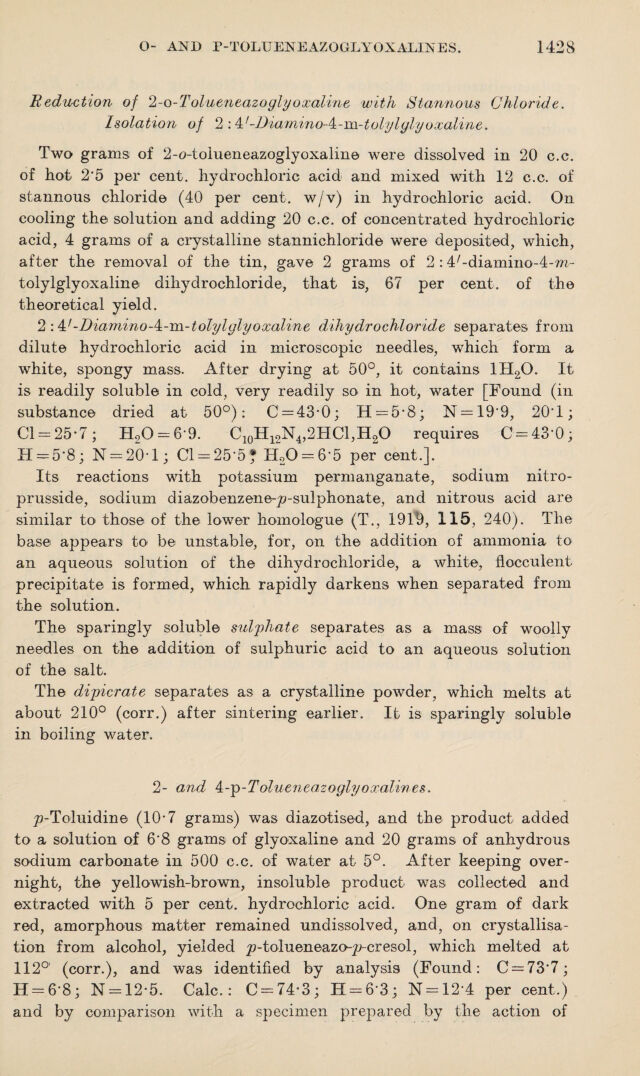
![Reduction of 2-o-Tolueneazoglyoxaline with Stannous Chloride. Isolation of 2-A'-DiaminoA-m-tolylglyoxaline. Two grams of 2-o-tolueneazoglyoxaline were dissolved in 20 c.c. of hot 2'5 per cent, hydrochloric acid and mixed with 12 c.c. of stannous chloride (40 per cent, w/v) in hydrochloric acid. On cooling the solution and adding 20 c.c. of concentrated hydrochloric acid, 4 grams of a crystalline stannichloride were deposited, which, after the removal of the tin, gave 2 grams of 2 :4/-diamino-4-m- tolylglyoxaline dihydrochloride, that is, 67 per cent, of the theoretical yield. 2 A'-DiaminoA-m.-tolylglyoxaline dihydrochloride separates from dilute hydrochloric acid in microscopic needles, which form a white, spongy mass. After drying at 50°, it contains 1H20. It is readily soluble in cold, very readily so in hot, water [Found (in substance dried at 50°): C = 43-0; H = 5'8; N = 19'9, 20'1; Cl = 25-7; H2G — 69. C10H12N4,2HCl,H2O requires C = 43 0; H = 5‘8; N = 20-l; Cl = 25-5? H20 = 6‘5 per cent.]. Its reactions with potassium permanganate, sodium nitro- prusside, sodium diazobenzene-p-sulphonate, and nitrous acid are similar to those of the lower homologue (T., 1919, 115, 240). The base appears to be unstable, for, on the addition of ammonia to an aqueous solution of the dihydrochloride, a white, flocculent precipitate is formed, which rapidly darkens when separated from the solution. The sparingly soluble sulphate separates as a mass of woolly needles on the addition of sulphuric acid to an aqueous solution of the salt. The dipicrate separates as a crystalline powder, which melts at about 210° (corr.) after sintering earlier. It is sparingly soluble in boiling water. 2- and k-p-Toluencazoglyoxalines. p-Toluidine (10’7 grams) was diazotised, and the product added to a solution of 6'8 grams of glyoxaline and 20 grams of anhydrous sodium carbonate in 500 c.c. of water at 5°. After keeping over¬ night, the yellowish-brown, insoluble product was collected and extracted with 5 per cent, hydrochloric acid. One gram of dark red, amorphous matter remained undissolved, and, on crystallisa¬ tion from alcohol, yielded ^-tolueneazo-p-cresol, which melted at 112° (corr.), and was identified by analysis (Found: C —73‘7; H = 6'8; N = 12-5. Calc.: C-74-3; H-6’3.; N = 12*4 per cent.) and by comparison with a specimen prepared by the action of](https://iiif.wellcomecollection.org/image/b30622633_0003.jp2/full/800%2C/0/default.jpg)