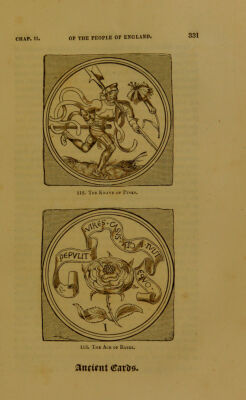
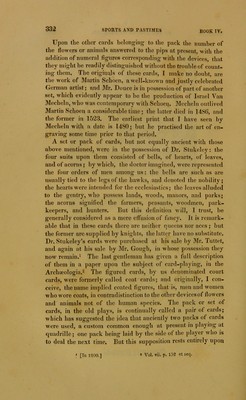
The sports and pastimes of the people of England including the rural and domestic recreations, May games, mummeries, shows, processions, pageants, and pompous spectacles, from the earliest period to the present time / By Joseph Strutt. Illustrated by one hundred and forty engravings.
- Joseph Strutt
- Date:
- 183l
Licence: Public Domain Mark
Credit: The sports and pastimes of the people of England including the rural and domestic recreations, May games, mummeries, shows, processions, pageants, and pompous spectacles, from the earliest period to the present time / By Joseph Strutt. Illustrated by one hundred and forty engravings. Source: Wellcome Collection.
398/490 (page 332)
![BOOK IV. Upon the other cards belonging to the pack the number of the flowers or animals answered to the pips at present, with the addition of numeral figures corresponding with the devices, that they might be readily distinguished without the trouble of count- ing them. The originals of these cards, I make no doubt, are the work of Martin Schoen, a well-known and justly celebrated German artist; and Mr. Douce is in possession of part of another set, which evidently appear to be the production of Israel Van Mecheln, who Avas contemporary with Schoeij. Mecheln outlived Martin Schoen a considerable time; the latter died in I486, and the former in 1523. The earliest print that I have seen by Mecheln with a date is 1480; but he practised the art of en- graving some time prior to that period. A set or pack of cards, but not equally ancient Avith those above mentioned, Avere in the possession of Dr. Stukeley: the four suits upon tlieni consisted of bells, of hearts, of leaves, and of acorns; by which, the doctor imagined, Avere represented the four orders of men among us: the bells are such as are usually tied to the legs of the hawks, and denoted the nobility; the hearts were intended for the ecclesiastics; the leaves alluded to the gentry, Avho possess lands, woods, manors, and parks; the acorns signified the farmers, peasants, Avoodmen, park- keepers, and hunters. But this definition Avill, I trust, be generally considered as a mere effusion of fancy. It is remark- able that in these cards there are neither queens nor aces; but the former are supplied by knights, the latter have no substitute. Dr. Stukeley’s cards Avere purchased at his sale by Mr. Tuttet, and again at his sale by Mr. Gough, in Avhose possession they noAV remain.' The last gentleman has given a full description of them in a paper upon the subject of card-playing-, in the Archseologia.^ The figured cards, by us denominated court cards, Avere formerly called coat cards; and originally, I con- ceive, the name implied coated figures, that is, men and w^omen who wore coats, in contradistinction to the other devices of flowers and animals not of the human species. The pack or set of cards, in the old plays, is continually called a pair of cards; which has suggested the idea that anciently two packs of cards were used, a custom common enough at present in playing at quadrille; one pack being laid by the side of the player Avho is to deal the next time. But this supposition rests entirely upon ? [In 1300.] » Vol. vii. p. 152 et seq.](https://iiif.wellcomecollection.org/image/b22013787_0398.jp2/full/800%2C/0/default.jpg)