Lessons in elementary chemistry : inorganic and organic / by Henry E. Roscoe.
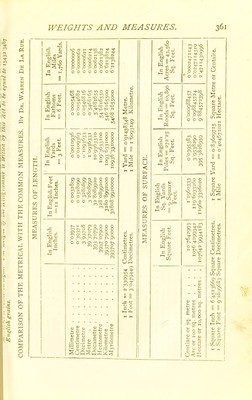
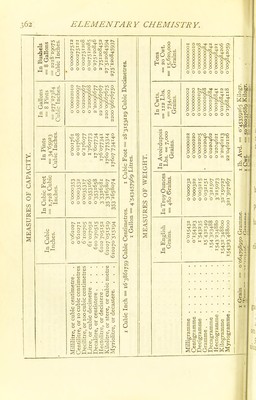
- Date:
- 1867
Licence: Public Domain Mark
Credit: Lessons in elementary chemistry : inorganic and organic / by Henry E. Roscoe. Source: Wellcome Collection.
Provider: This material has been provided by the Royal College of Physicians of Edinburgh. The original may be consulted at the Royal College of Physicians of Edinburgh.
382/422 (page 364)
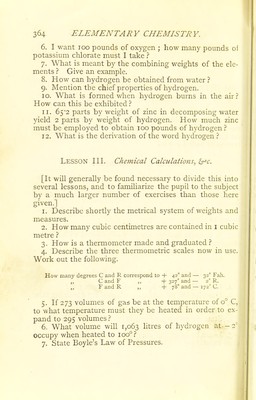
![6. I want 100 pounds of oxygen ; how many pounds of potassium chlorate must I take ? 7. What is meant by the combining weights of the ele- ments ? Give an example. 8. How can hydrogen be obtained from water? 9. Mention the chief properties of hydrogen. 10. What is formed when hydrogen burns in the air? How can this be exhibited? 11. 65*2 parts by weight of zinc in decomposing water yield 2 parts by weight of hydrogen. How much zinc must be employed to obtain 100 pounds of hydrogen ? 12. What is the derivation of the word hydrogen ? Lesson III. Chemical Calculations, &c. [It will generally be found necessary to divide this into several lessons, and to familiarize the pupil to the subject by a much larger number of exercises than those here given.] 1. Describe shortly the metrical system of weights and measures. 2. How many cubic centimetres are contained in 1 cubic metre ? 3. How is a thermometer made and graduated ? 4. Describe the three thermometric scales now in use. Work out the following. How many degrees C and R correspond to + 42° and — 32° Fah. „ C and F ,, + 327° and — 2° R. „ F and R ,, 4- 78° and — 172' C. 5. If 273 volumes of gas be at the temperature of o° C, to what temperature must they be heated in order to ex- pand to 295 volumes ? 6. What volume will 1,063 litres of hydrogen at - r occupy when heated to ioo°? 7. State Boyle's Law of Pressures.](https://iiif.wellcomecollection.org/image/b21927972_0382.jp2/full/800%2C/0/default.jpg)